CNS anatomy and physiology PowerPoint Template





Template Preview
Designed for healthcare professionals creating clear and structured medical presentations.
Ideal for doctors, medical educators, and pharmaceutical teams preparing lectures, clinical education, product presentations, and training.
Fully editable in PowerPoint, allowing you to customize diagrams, charts, and slide layouts with your own medical content
Ready-to-use presentation structure that saves time and helps you build professional healthcare presentations quickly.
Fully Animated
Built-in animations help you present medical information clearly and make complex concepts easier to understand.
Editable Colors and Shapes
Editable colors and shapes help you easily customize the slides to match your content and presentation style, just drag and drop your content.
Professional medical layouts
Professional medical layouts help you organize clinical information, medical data, and treatment insights in a clear and structured way.

Created by Medical Professionals
This template prioritizes medical accuracy, clarity, and real-world usability. Each slide is designed with a medical audience in mind, helping you present clinical information, data, and treatment insights in a way that is structured, credible, and easy for healthcare professionals to understand.
Medical Training for Pharmaceutical & Life Sciences Companies
Foundational neuroanatomy training doesn't need to start from a blank page: the template's cranial nerve table and cerebrum lobe illustrations already give neurology- and CNS-focused training teams a base to build from before any single disease-state program begins. New hires study the thalamus and hypothalamus function slides, covering roles from sensory relay to the nine autonomic functions the hypothalamus regulates, ahead of holding conversations that reference CNS drug targets. The spinal cord cross-section and reflex arc diagram give trainers a scientifically accurate anatomical baseline without needing a neuroanatomy illustrator on staff. That shared vocabulary carries forward into every disease-specific training the team builds afterward.

Medical Congress & Scientific Conference Presentations
Multi-speaker neuroscience symposia need shared anatomical terminology before speakers diverge into disease-specific talks, and the template's cranial nerve table and cerebrum lobe diagrams give neurologists and academic Key Opinion Leaders that foundation without assembling references from separate textbooks. A medical professor opening the program can use the basal ganglia and thalamus function slides to establish that common ground before individual speakers take the floor. The meninges and spinal cord cross-section content gives an anatomy-heavy session a clear visual foundation before clinical correlation begins. This template works best as the shared anatomical grounding a multi-speaker program needs before diverging into individual disease topics.
Pharmaceutical Product & Medical Affairs Presentations
Establishing the anatomical context a CNS therapy acts on is faster with the template's cerebrum, thalamus, and hypothalamus slides already built, giving Medical Affairs teams a ready foundation for a drug program instead of commissioning new brain-region artwork. Medical Science Liaisons use the resulting materials as a shared reference point in scientific exchange with neurologists, grounding mechanism discussions in the same anatomical terminology those clinicians already use. Because the forebrain, midbrain, and hindbrain content is organized separately, Medical Affairs can adjust which regions receive emphasis depending on a compound's target area. The template supplies the anatomical foundation; therapy-specific claims and promotional review remain entirely the customer's own process.

eLearning & SCORM Training Modules
Turning this CNS Anatomy and Physiology template into LMS-ready coursework starts with customization: neuroscience and nursing educators build in their own institutional curriculum sequencing, then can optionally convert the result into a SCORM-compliant module for students. On its own, the template is a comprehensive slide library rather than a paced course. Because the brain-to-spinal-cord content already moves from gross anatomy through cellular physiology to systemic function, a customized version becomes certification-ready SCORM coursework without reordering the underlying material. Where a curriculum needs a narrower or broader scope, the RxSlides team can adjust depth and branding, or build a fully custom neuroanatomy presentation from scratch.
Medical & Healthcare Education
Medical and nursing school faculty teaching a neuroanatomy unit can use the template's cranial nerve table and cerebrum lobe illustrations to give students a complete anatomical map before moving into physiology, instead of assembling reference diagrams from multiple textbooks. Neuroscience programs covering cellular physiology benefit from the same synaptic transmission and reflex arc content, without rebuilding mechanism diagrams every semester. Editable spinal cord and meninges slides let an instructor go as deep as a given course level requires, from an introductory overview to detailed cross-sectional anatomy. Students leave with a structured foundation connecting brain anatomy to spinal cord function and clinical relevance.
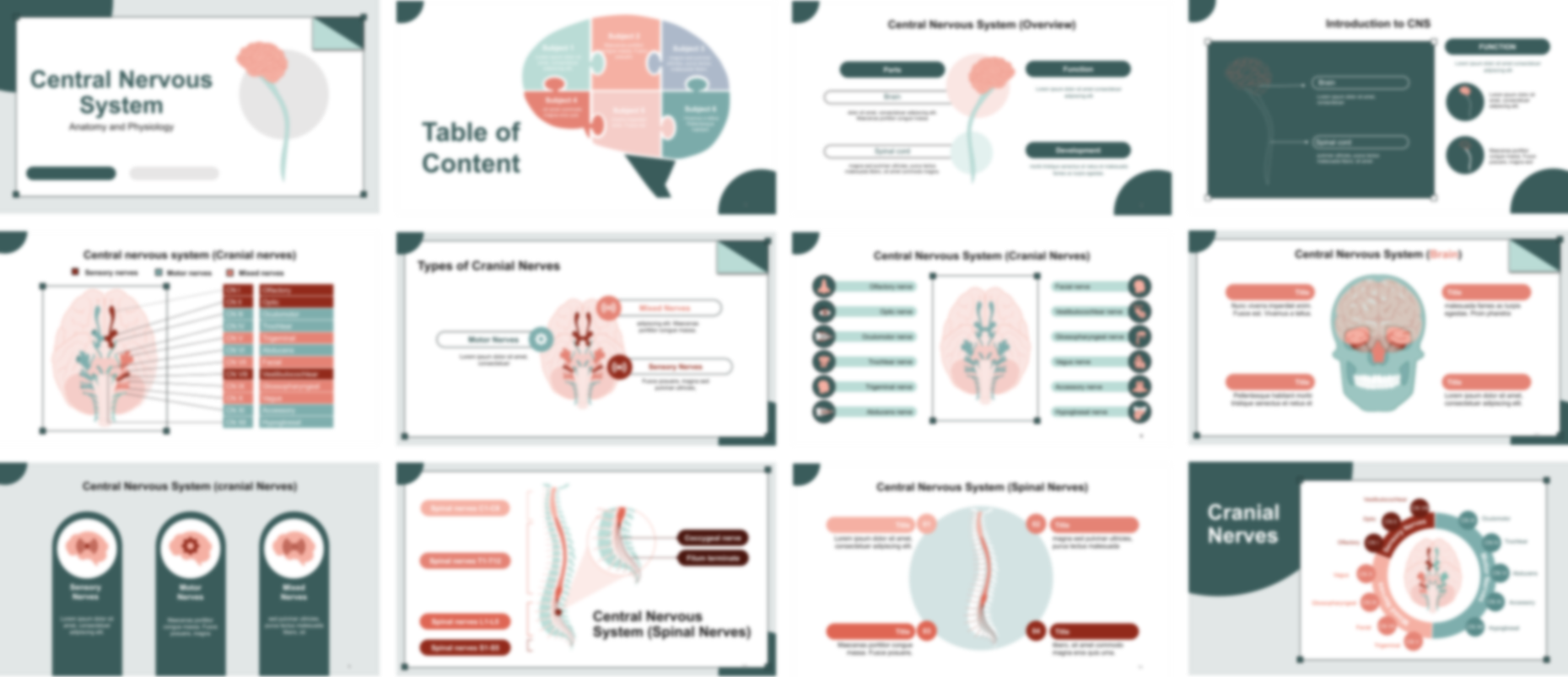
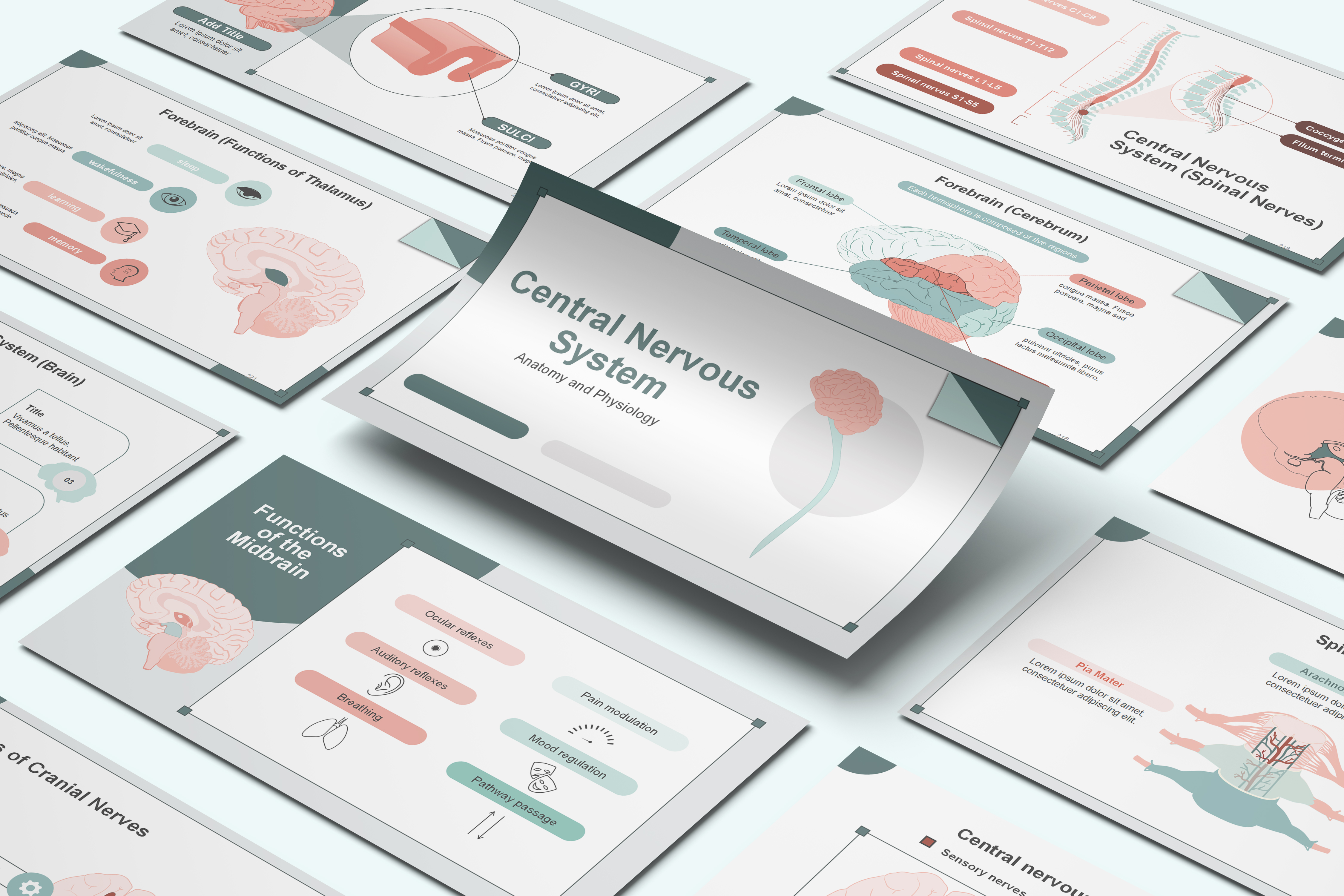
The CNS Anatomy and Physiology PowerPoint template opens with a foundational overview slide uniting the brain and spinal cord before a comprehensive reference table links each of the twelve cranial nerves to its anatomical location and functional category. A color coded spinal column diagram then segments the spinal nerves into cervical, thoracic, lumbar, and sacral groups.
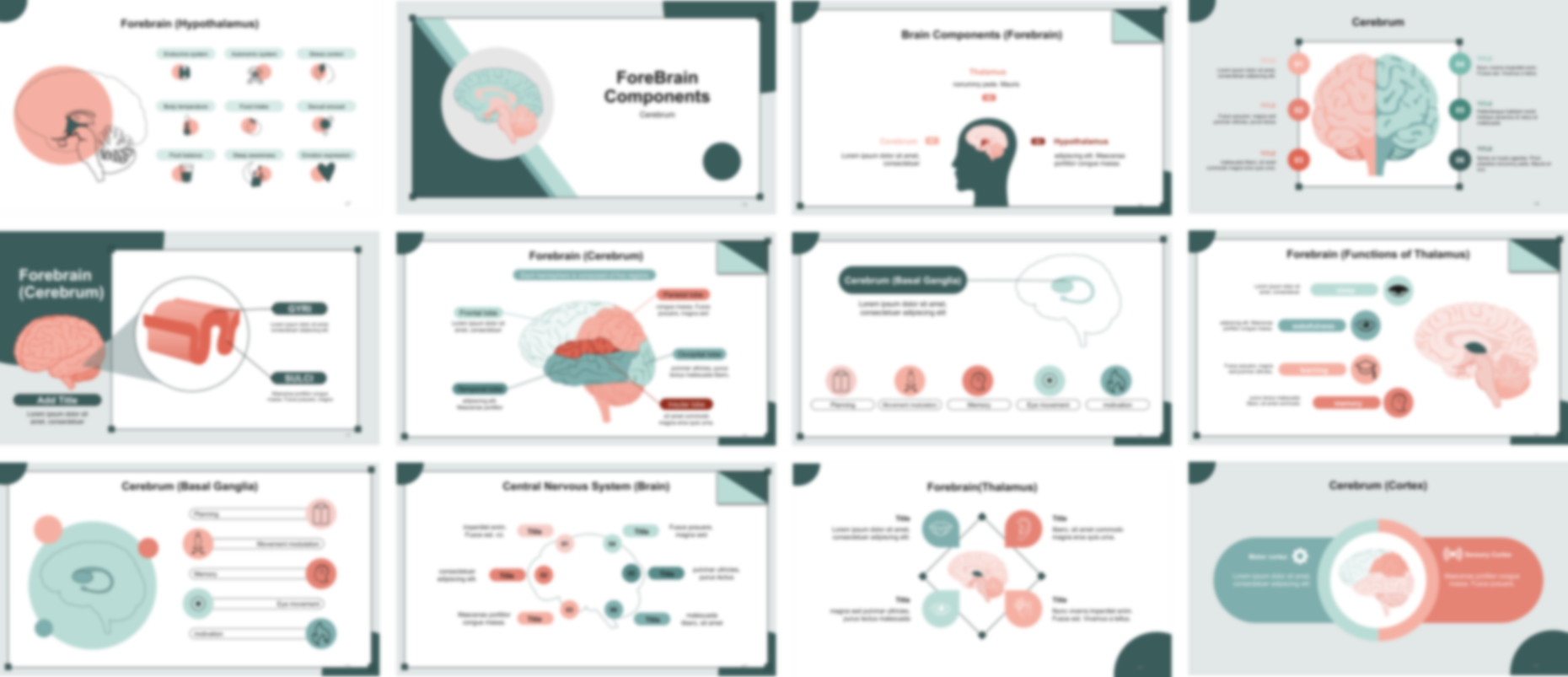
Detailed diagrams color code the five lobes of the cerebrum, including the often overlooked insular lobe, before icon based content bubbles explain the basal ganglia's role in planning, movement, and motivation. Establishing this lobe by lobe foundation first gives educators a shared reference point before the sequence details the thalamus as the brain's relay station and the nine autonomic functions controlled by the hypothalamus in a set of editable medical diagrams.
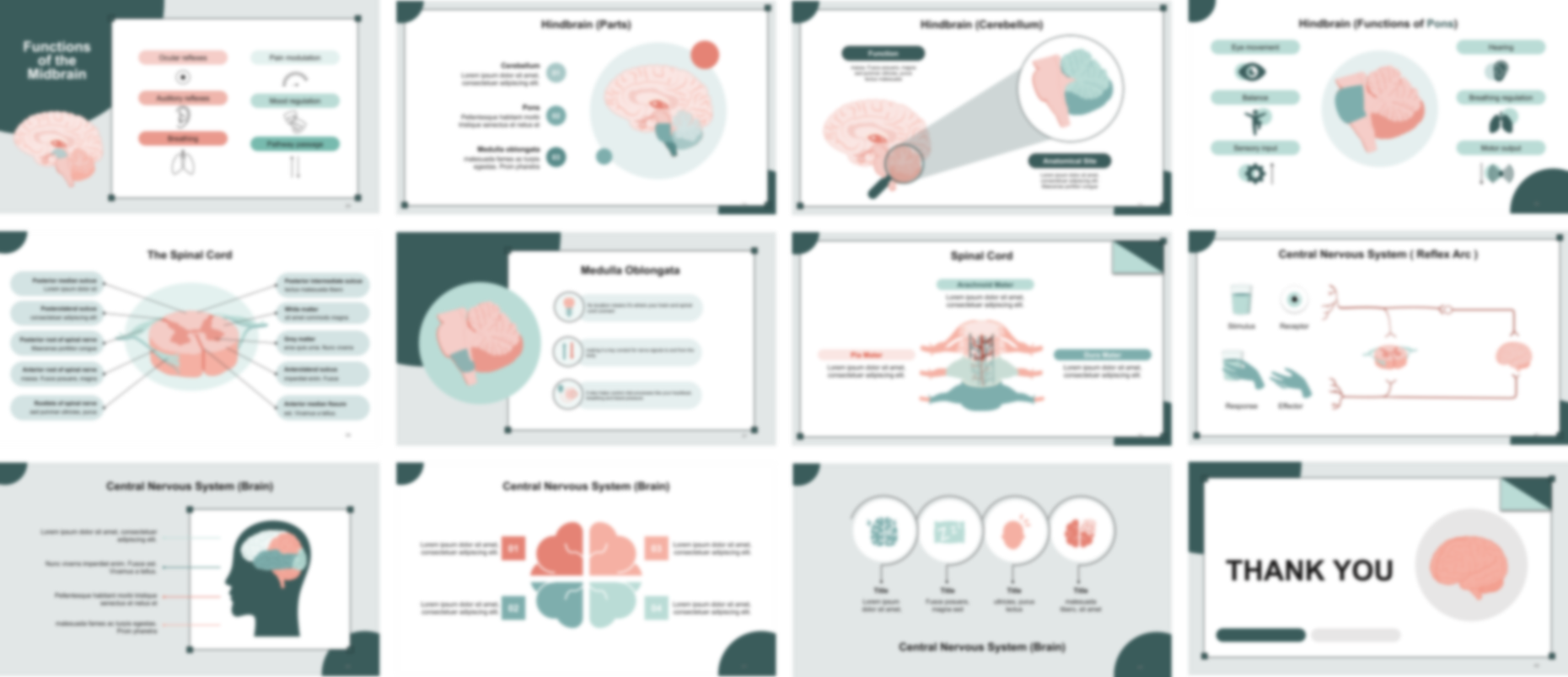
The template devotes dedicated sections to the midbrain, pons, and medulla oblongata before a magnifying glass effect isolates the cerebellum, or little brain, for focused discussion of its structure and function. A highly detailed cross section then labels ten key structures of the spinal cord, including its white and gray matter, nerve roots, and protective meninges.
An animated diagram maps the complete path of a nerve impulse during the reflex arc, from stimulus to response through the spinal cord, alongside functional areas for sleep, memory, and stress. The presentation closes with specialized editable PowerPoint slides for discussing neurological disorders such as Alzheimer's disease and PTSD, plus diagnostic concepts and a range of infographics, comparison tables, and timeline slides.
Ready To Transform Your Presentation ?
Pay once, use forever