Pneumonia PowerPoint Template




Template Preview
Designed for healthcare professionals creating clear and structured medical presentations.
Ideal for doctors, medical educators, and pharmaceutical teams preparing lectures, clinical education, product presentations, and training.
Fully editable in PowerPoint, allowing you to customize diagrams, charts, and slide layouts with your own medical content
Ready-to-use presentation structure that saves time and helps you build professional healthcare presentations quickly.
Fully Animated
Built-in animations help you present medical information clearly and make complex concepts easier to understand.
Editable Colors and Shapes
Editable colors and shapes help you easily customize the slides to match your content and presentation style, just drag and drop your content.
Professional medical layouts
Professional medical layouts help you organize clinical information, medical data, and treatment insights in a clear and structured way.

Created by Medical Professionals
This template prioritizes medical accuracy, clarity, and real-world usability. Each slide is designed with a medical audience in mind, helping you present clinical information, data, and treatment insights in a way that is structured, credible, and easy for healthcare professionals to understand.
Medical Training for Pharmaceutical & Life Sciences Companies
Medical Affairs and Training teams building respiratory infectious disease onboarding can use this animated Pneumonia template to walk new hires through lung anatomy, the distinction between community-acquired, hospital-acquired, and ventilator-associated pneumonia, and the bacterial, viral, and fungal causes behind each. Sales trainees and Medical Science Liaisons supporting an anti-infective or respiratory portfolio get a visual reference for diagnostic workup, including chest imaging, sputum culture, and pulse oximetry, alongside antibiotic and oxygen therapy content. Because the slide library already separates causes, symptoms, diagnosis, and treatment into distinct sections, trainers can adapt individual modules to their own onboarding timeline. New hires leave training able to explain pneumonia classification and the clinical rationale behind treatment selection.
Medical Congress & Scientific Conference Presentations
Pulmonologists, infectious disease specialists, and internal medicine physicians preparing a conference talk or CME session on pneumonia can adapt this animated template rather than rebuilding lung-infection illustrations for each presentation. The classification content distinguishing community-acquired, hospital-acquired, and ventilator-associated pneumonia gives a speaker a ready framework for a case-based discussion with a specialist or generalist audience alike. Diagnostic and severity-assessment slides support a technically detailed session, while the prevalence and disease-burden infographics offer a quick swap-in point for a presenter's own institutional or regional statistics. A Key Opinion Leader speaking at multiple respiratory meetings can reuse the animated illustrations across sessions of varying depth.

Pharmaceutical Product & Medical Affairs Presentations
Medical Affairs teams supporting an antibiotic or respiratory product can use this Pneumonia presentation as neutral disease-state groundwork for scientific exchange, covering microbiology, the community-acquired versus hospital-acquired distinction, and the clinical rationale behind antibiotic selection and oxygen therapy without referencing a specific brand. Medical Science Liaisons can deliver the customized, animated slides at advisory boards or KOL scientific discussions to establish shared understanding before any product-specific efficacy or safety data is introduced. Because the template remains disease-focused, it functions as a starting point still subject to the customer's own medical and compliance review ahead of any field use. Respiratory and infectious disease teams gain a consistent scientific reference across multiple therapeutic conversations.

eLearning & SCORM Training Modules
Learning & Development teams training new infectious disease fellows or respiratory nursing staff can customize this Pneumonia template with their own case studies and protocols, then convert the finished presentation into a SCORM-compliant module for their learning management system when self-paced training is the better format. The animated pathogenesis and severity-assessment slides translate well into interactive checkpoints within an e-learning course on respiratory infection. Programs that need something narrower, a diagnosis-focused refresher rather than a full disease overview, can ask the RxSlides team to adjust the template's depth and branding. Where no existing template is the right fit at all, a fully custom presentation can be designed from scratch to match the specific training goal.
Medical & Healthcare Education
Medical school and nursing faculty teaching respiratory infectious disease can use this animated template to walk students through lung anatomy and the pathogenesis of pneumonia without building infection illustrations independently. The side-by-side classification of bacterial, viral, and fungal causes helps students connect microbiology coursework to real diagnostic and treatment decisions. Severity-assessment and complication content, including respiratory failure and sepsis, gives instructors a clear teaching arc from initial presentation to critical outcomes. Students gain a structured understanding of how pneumonia is diagnosed and managed across different clinical settings.


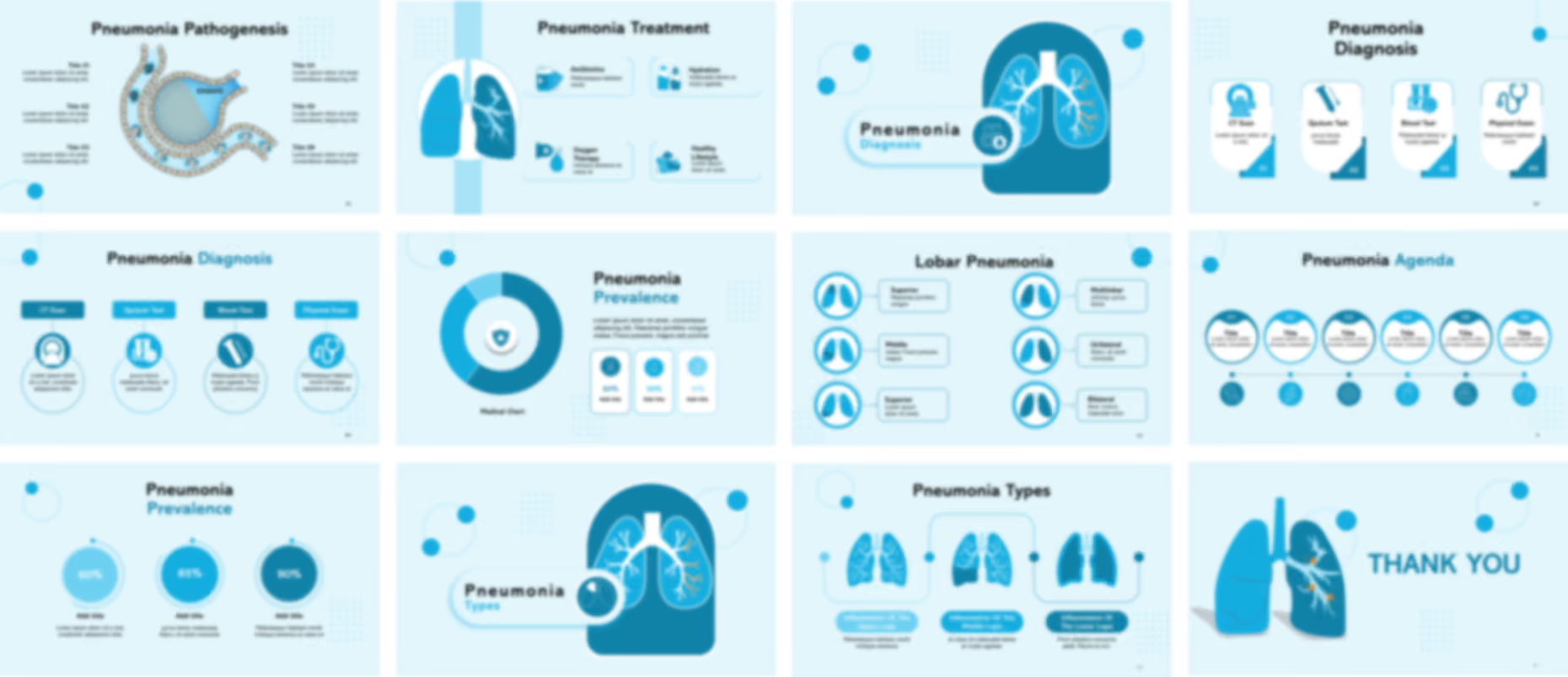
The Pneumonia PowerPoint template opens with a stylized lung illustration highlighting pulmonary infection before a six step circular infographic outlines the presentation agenda. A definition slide then frames the condition with a distinct callout box, followed by an overview slide built around a clean, medical themed lung illustration in a set of editable PowerPoint slides.
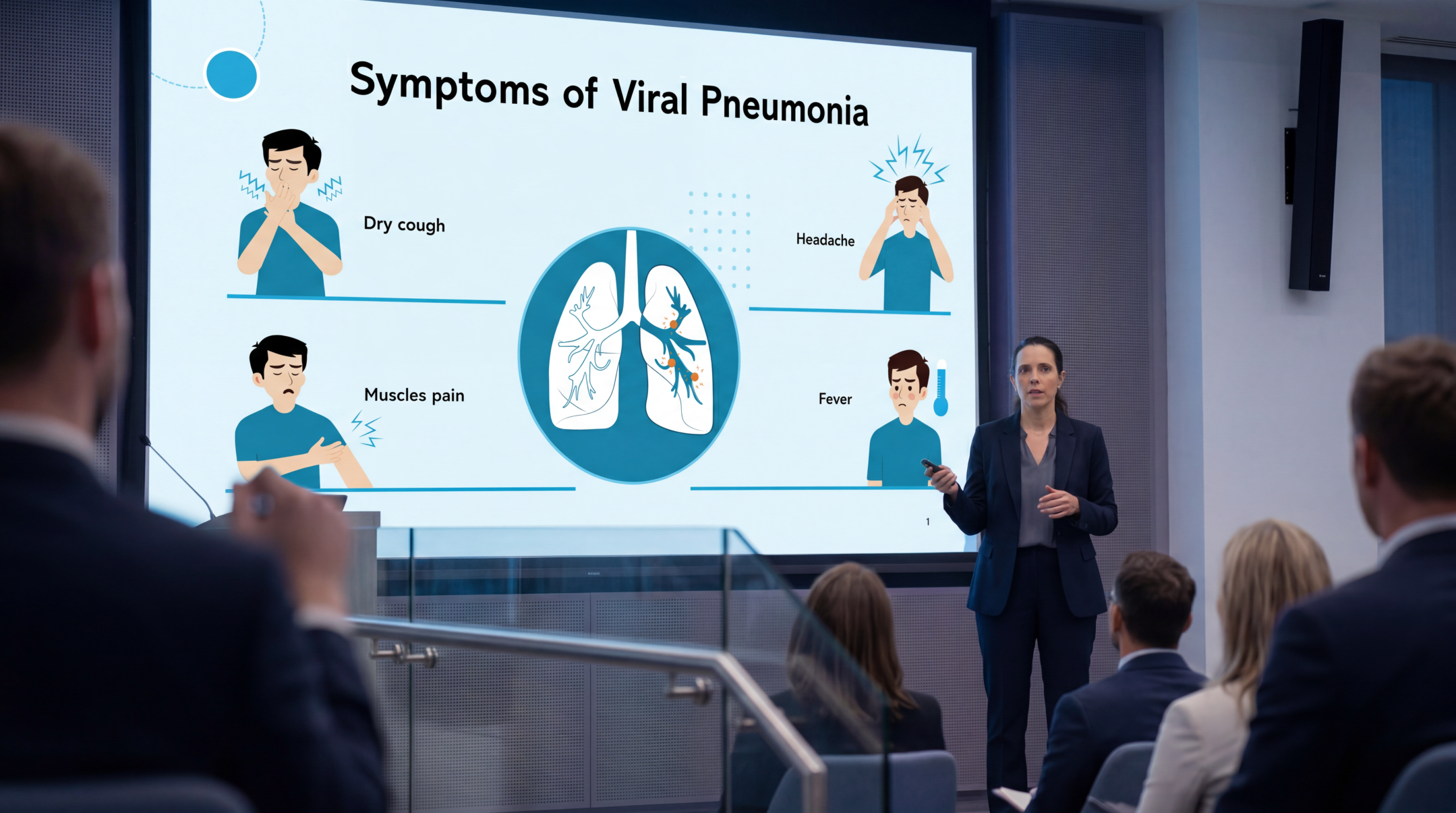
Character illustrations depict symptoms including bluish skin, high fever, fatigue, shortness of breath, dizziness, headache, and pale skin. Establishing these general symptoms first gives educators a shared reference point before a dedicated slide narrows into viral pneumonia specifically, showing dry cough, muscle pain, headache, and fever.
Icon driven layouts outline four primary risk factors, smoking, weakened immunity, chronic illness, and hospitalization, presented across circular and sidebar infographic formats. A section slide then visualizes the pathogenesis of pneumonia, showing how infectious agents enter and inflame the lungs.
The template outlines three causes, bacterial, viral, and fungal infection, before classifying lobar pneumonia by superior, middle, and multilobar lung involvement, and a donut chart presents prevalence data across demographics. The presentation closes with diagnostic methods including chest x-ray, CT scan, sputum test, blood test, and physical exam, treatment through antibiotics, oxygen therapy, and hospital care, and prevention strategies such as vaccination, smoking cessation, and reduced alcohol use in a set of editable medical icons and infographics.
Ready To Transform Your Presentation ?
Pay once, use forever