Alzheimer's Disease PowerPoint Template





Template Preview
Designed for healthcare professionals creating clear and structured medical presentations.
Ideal for doctors, medical educators, and pharmaceutical teams preparing lectures, clinical education, product presentations, and training.
Fully editable in PowerPoint, allowing you to customize diagrams, charts, and slide layouts with your own medical content
Ready-to-use presentation structure that saves time and helps you build professional healthcare presentations quickly.
Fully Animated
Built-in animations help you present medical information clearly and make complex concepts easier to understand.
Editable Colors and Shapes
Editable colors and shapes help you easily customize the slides to match your content and presentation style, just drag and drop your content.
Professional medical layouts
Professional medical layouts help you organize clinical information, medical data, and treatment insights in a clear and structured way.

Created by Medical Professionals
This template prioritizes medical accuracy, clarity, and real-world usability. Each slide is designed with a medical audience in mind, helping you present clinical information, data, and treatment insights in a way that is structured, credible, and easy for healthcare professionals to understand.
Medical Training for Pharmaceutical & Life Sciences Companies
This editable, animated template turns Alzheimer's disease education into a structured internal training resource for neurology and dementia-focused pharmaceutical companies. It traces the amyloidogenic pathway from APP processing through plaque formation and synaptic disruption, then maps disease staging from preclinical changes through mild cognitive impairment to full dementia. Current treatment options, from cholinesterase inhibitors to the newer agent lecanemab, are covered in the same sequence. Sales representatives are trained on the finished material and draw on that grounding during promotional conversations with neurologists. The result is a scientifically current foundation that shortens preparation time and keeps field messaging consistent.

Medical Congress & Scientific Conference Presentations
Neuroscience researchers and Key Opinion Leaders preparing a congress talk or thesis defense can adapt this editable, animated template's amyloid pathway sequence instead of assembling brain pathology diagrams from separate journal figures. The slides trace amyloid beta production, aggregation, and plaque-induced synaptic disruption as a structured mechanistic narrative, then connect it to disease staging and treatment. The underlying animations stay intact while a presenter adds research data or case findings from their own work. Congress-ready neuropathology visuals let the speaker focus on the science, not slide design.

Pharmaceutical Product & Medical Affairs Presentations
This editable template gives a neurology or dementia Medical Affairs team a foundation for internal training, scientific exchange resources, and clinical case discussion materials on Alzheimer's disease. It covers the amyloid cascade, disease staging, and the current treatment landscape, including Donepezil, Memantine, and Lecanemab, giving Medical Affairs a framework to layer in their own clinical evidence. Medical Science Liaisons then carry the finished materials into scientific exchange with neurologists and dementia specialists. The scientific narrative holds steady from one MSL to the next precisely because this is an editable starting point, not a finished promotional asset, pending each company's own medical and compliance review.

eLearning & SCORM Training Modules
This editable template becomes Learning Management System-ready training for neurology trainees, nursing staff, or caregiver education cohorts only after the buyer customizes it with their own content. Converting that finished presentation into a SCORM-compliant module is an optional next step, not something the base file already does. Because brain anatomy, pathophysiology, staging, and treatment already follow a teaching sequence, a customized version can reach certification-ready SCORM status without reorganizing the content first. The RxSlides team is also available to adjust scope, depth, or branding for a specific training program, or to design a fully custom presentation from scratch when an existing template doesn't fit.
Medical & Healthcare Education
Medical school faculty, nursing educators, and neuroscience program directors teaching Alzheimer's disease can skip rebuilding brain pathology animations each term by starting from this editable template. It opens with brain and neuron anatomy, then walks students through the amyloid cascade, disease staging, and the dementia comparison before covering treatment and prevention. The sequence gives Alzheimer's a clear teaching arc for medical school, nursing, and CME settings, rather than a dense research summary. Faculty set the depth for a preclinical, clinical, or continuing-education audience once, then reuse the same slides across cohorts, cutting prep time while giving students a more visual way to learn the material.
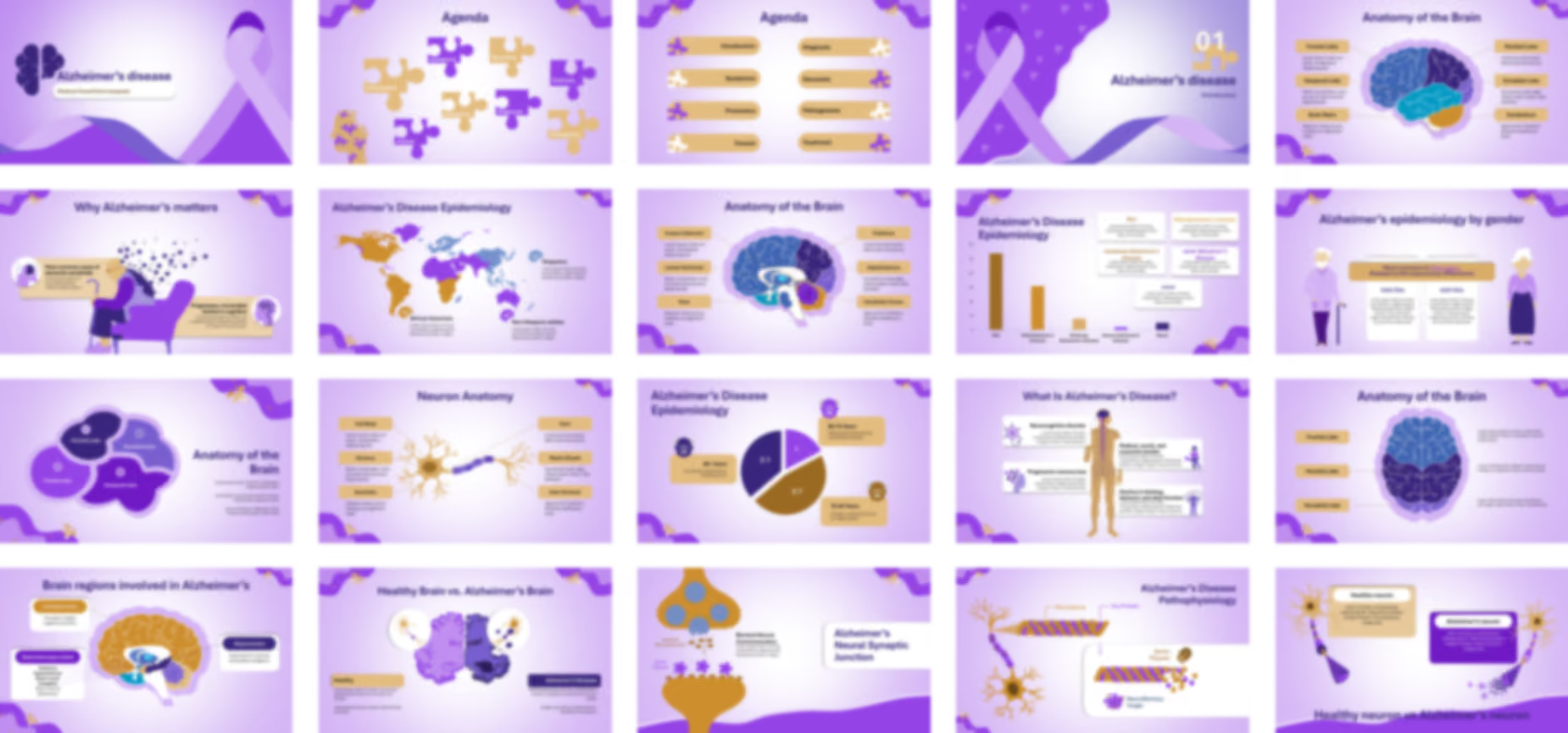
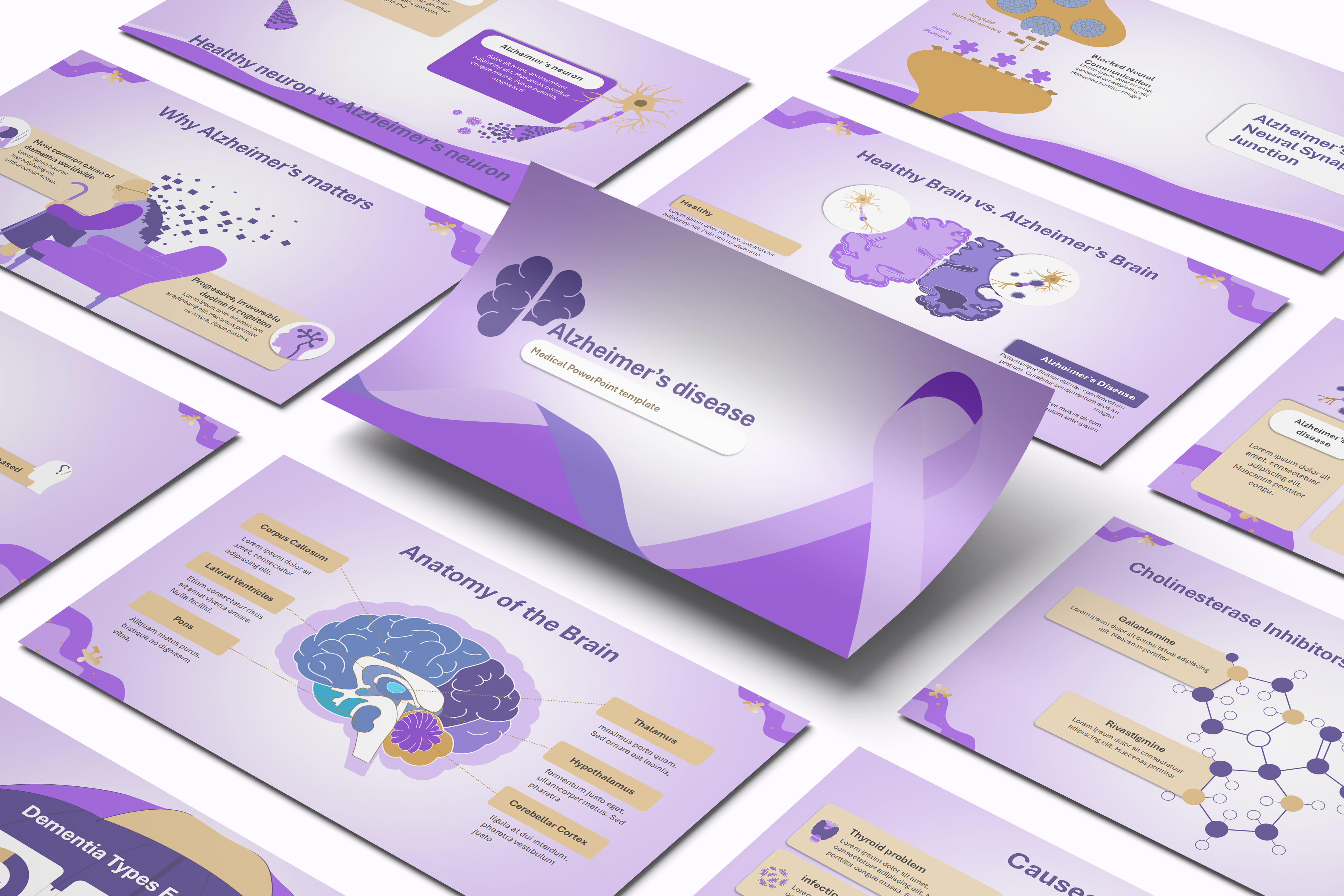
The presentation template opens with cover slides and an editable table of contents before animated introductory illustrations compare the normal and diseased brain. Animated charts then visualize epidemiology across African American, Hispanic, and non-Hispanic white populations and the ages most affected, and a detailed anatomy sequence labels the brain's lobes, brain stem, cerebellum, and other structures alongside the neural cell components, cell body, nucleus, dendrites, axon, myelin sheath, and axon terminals.
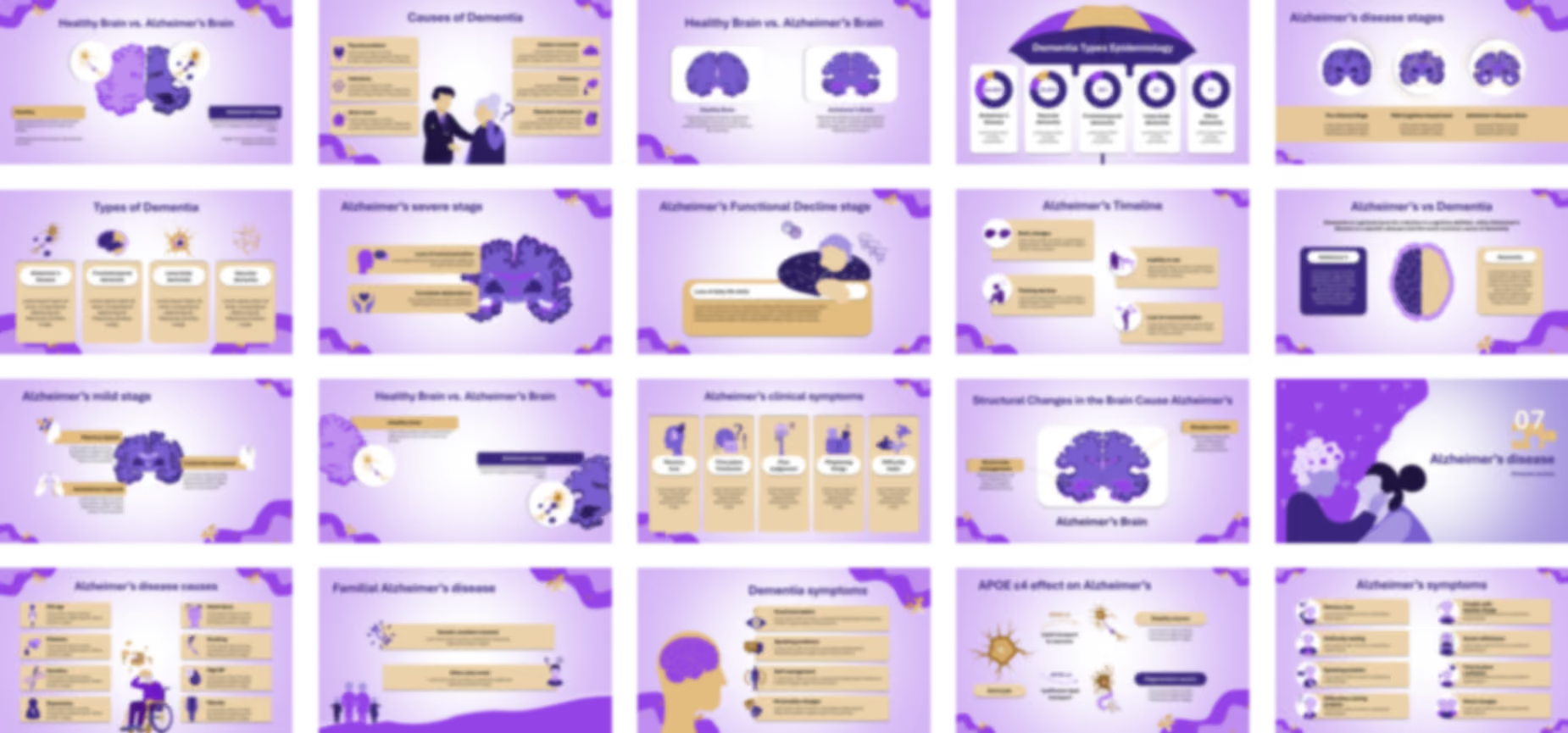
Animated structures trace the two pathways of amyloid precursor protein processing, the non-amyloidogenic pathway that clears fragments safely and the amyloidogenic pathway that produces the amyloid beta monomers behind Alzheimer's, before further animations show plaque formation and how these plaques block neurotransmitters at the synapse to disrupt communication between neurons. Establishing this mechanism first gives the sequence a foundation before animated illustrations stage the disease from the preclinical phase through mild cognitive impairment to the Alzheimer's disease brain, tracked along an animated timeline of brain changes, thinking decline, memory changes, and loss of communication.
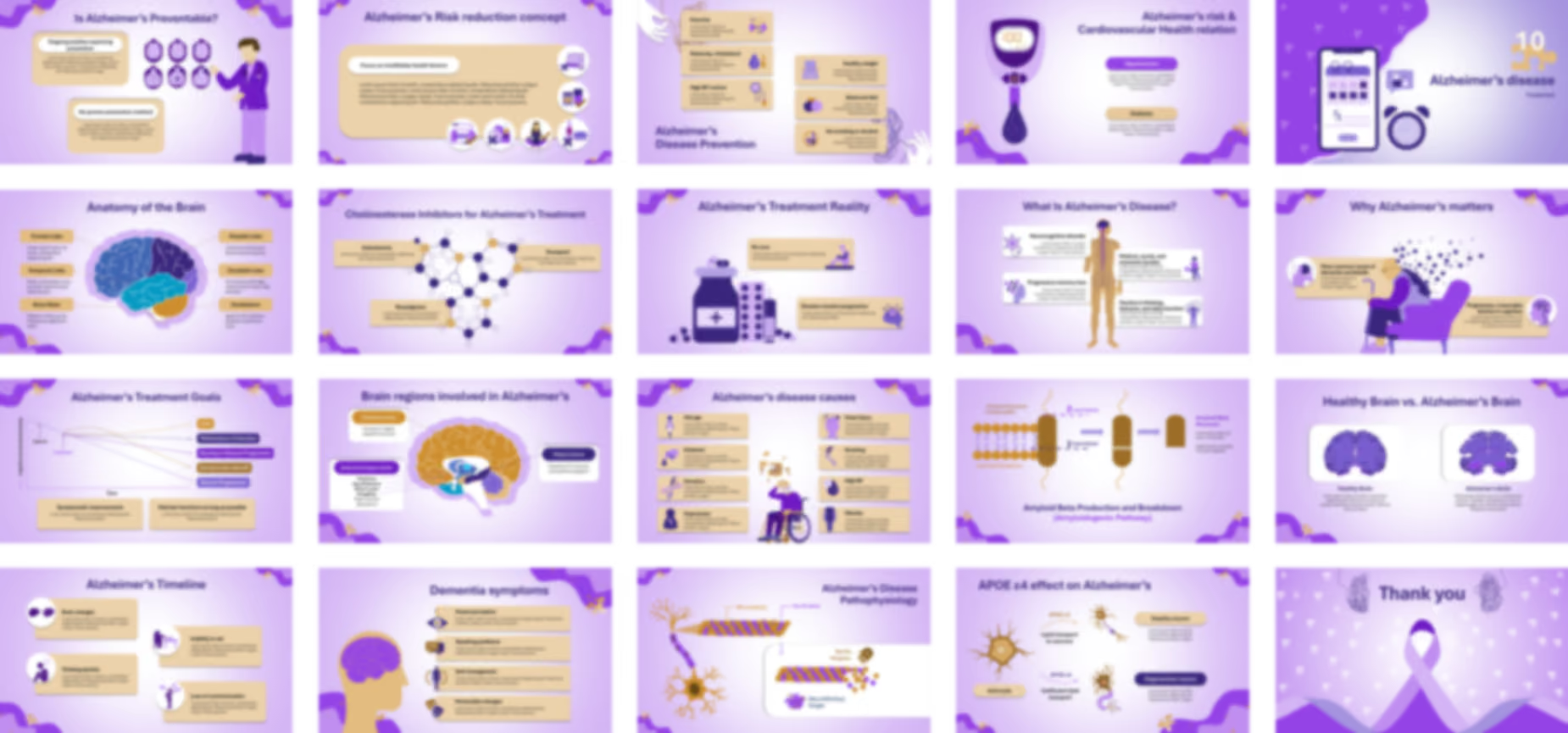
The template dedicates a comparative section to dementia, contrasting it against Alzheimer's disease and visualizing dementia's causes, including thyroid problems, infections, brain tumors, carbon monoxide, diabetes, and elevated cholesterol, alongside its symptoms, including thinking difficulties, memory loss, and personality changes. Separate animated icons then cover Alzheimer's specific causes, old age, head injury, diabetes, smoking, genetics, high blood pressure, depression, and obesity, and its symptoms, including memory loss, confusion with time and place, and social withdrawal.
The presentation template lists treatment options with medical icons, including brexpiprazole, donepezil, galantamine, memantine, rivastigmine, and lecanemab, alongside prevention methods such as exercise, reduced cholesterol, controlling blood pressure, a healthy weight, a balanced diet, and avoiding smoking or alcohol. A closing set of editable PowerPoint illustrations and medical icons supports customizing the presentation to a specific audience.
Ready To Transform Your Presentation ?
Pay once, use forever