Iron Deficiency Anemia PowerPoint Template




Template Preview
Designed for healthcare professionals creating clear and structured medical presentations.
Ideal for doctors, medical educators, and pharmaceutical teams preparing lectures, clinical education, product presentations, and training.
Fully editable in PowerPoint, allowing you to customize diagrams, charts, and slide layouts with your own medical content
Ready-to-use presentation structure that saves time and helps you build professional healthcare presentations quickly.
Fully Animated
Built-in animations help you present medical information clearly and make complex concepts easier to understand.
Editable Colors and Shapes
Editable colors and shapes help you easily customize the slides to match your content and presentation style, just drag and drop your content.
Professional medical layouts
Professional medical layouts help you organize clinical information, medical data, and treatment insights in a clear and structured way.

Created by Medical Professionals
This template prioritizes medical accuracy, clarity, and real-world usability. Each slide is designed with a medical audience in mind, helping you present clinical information, data, and treatment insights in a way that is structured, credible, and easy for healthcare professionals to understand.
Medical Training for Pharmaceutical & Life Sciences Companies
Hematology and women's-health sales teams can build Iron Deficiency Anemia onboarding around the template's ferric-to-ferrous absorption animation and the erythropoiesis sequence, tracing RBC formation in the bone marrow step by step. Representatives study the heme-versus-non-heme iron forms and the four-cause breakdown, blood loss, dietary deficiency, absorption failure, and pregnancy, before they are cleared to hold promotional conversations with hematologists and OB-GYNs. The dedicated pregnancy section, covering trimester-specific iron requirements and fetal consequences, gives trainers a population-specific foundation without commissioning new maternal-health artwork. New hires reach the field able to connect the absorption mechanism to both general and pregnancy-specific management.
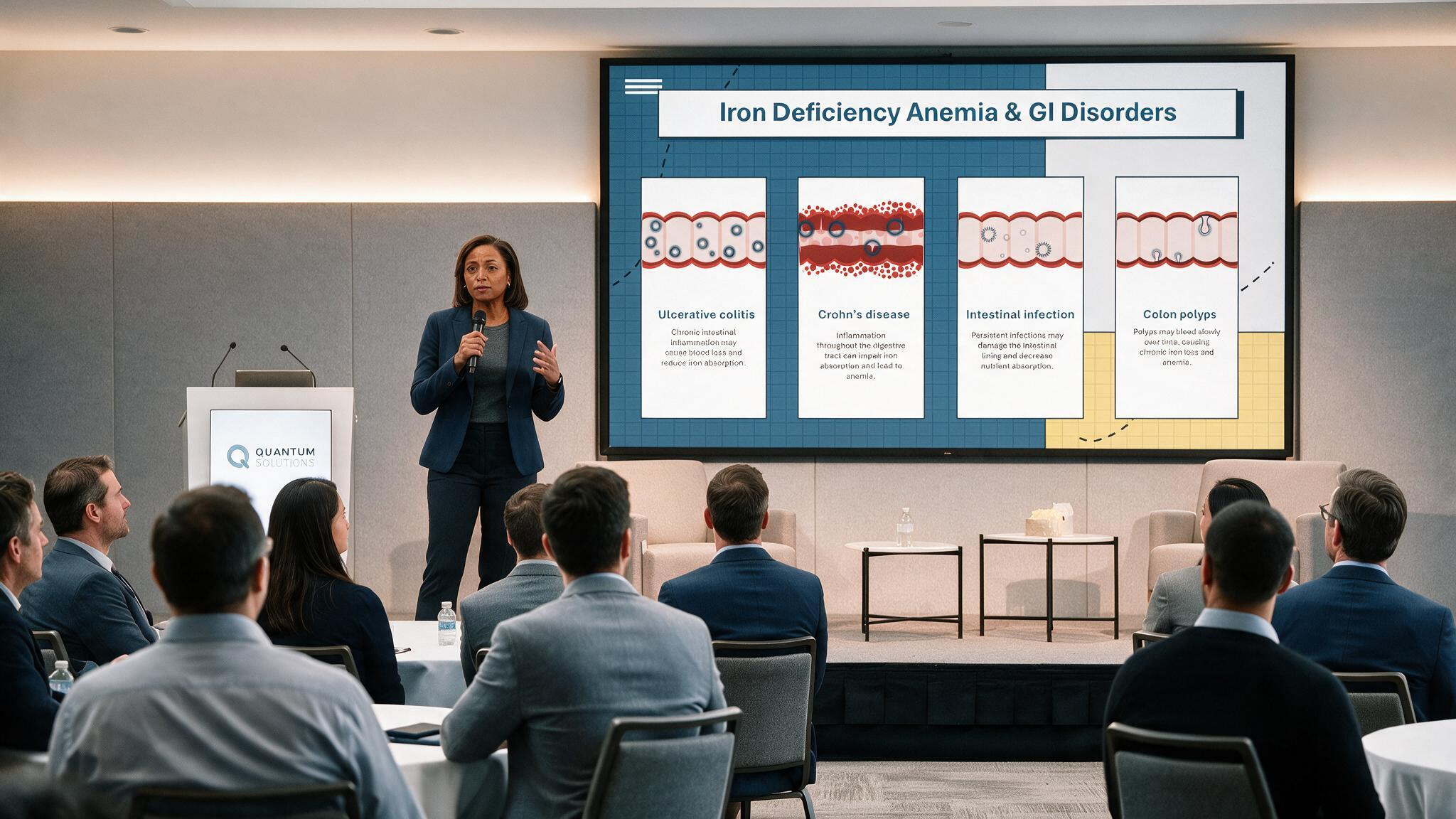
Medical Congress & Scientific Conference Presentations
Hematologists and academic Key Opinion Leaders preparing an anemia congress session can start from the template's pathophysiology sequence, tracing the transformation from normal to microcytic red blood cells, instead of assembling cellular illustrations from separate sources. A medical professor lecturing on differential diagnosis can adapt the four-condition comparison, anemia of chronic disease, microcytic anemia, autoimmune hemolytic anemia, and lead poisoning, to walk through a structured diagnostic workup. The diagnostic-criteria slides, covering hemoglobin, MCV, serum iron, and TIBC, give a case presentation a clear laboratory anchor before the discussion turns to treatment. The presenter's own laboratory results and case data slot into the existing structure without touching the underlying illustrations.

Pharmaceutical Product & Medical Affairs Presentations
Medical Affairs teams supporting a hematology or women's-health portfolio can adapt the template's pathophysiology and staging slides to position an iron-repletion therapy within the three-stage progression of iron deficiency. Medical Science Liaisons carry the resulting materials into scientific exchange with hematologists and OB-GYNs, referencing the same TIBC and RDW diagnostic data those clinicians already use to confirm a diagnosis. Because the general and pregnancy-specific content is organized in separate sections, Medical Affairs can shift emphasis toward a specific patient population without commissioning new illustrations. Medical Affairs retains full control over promotional review; the template only supplies an already-accurate scientific foundation to build against.
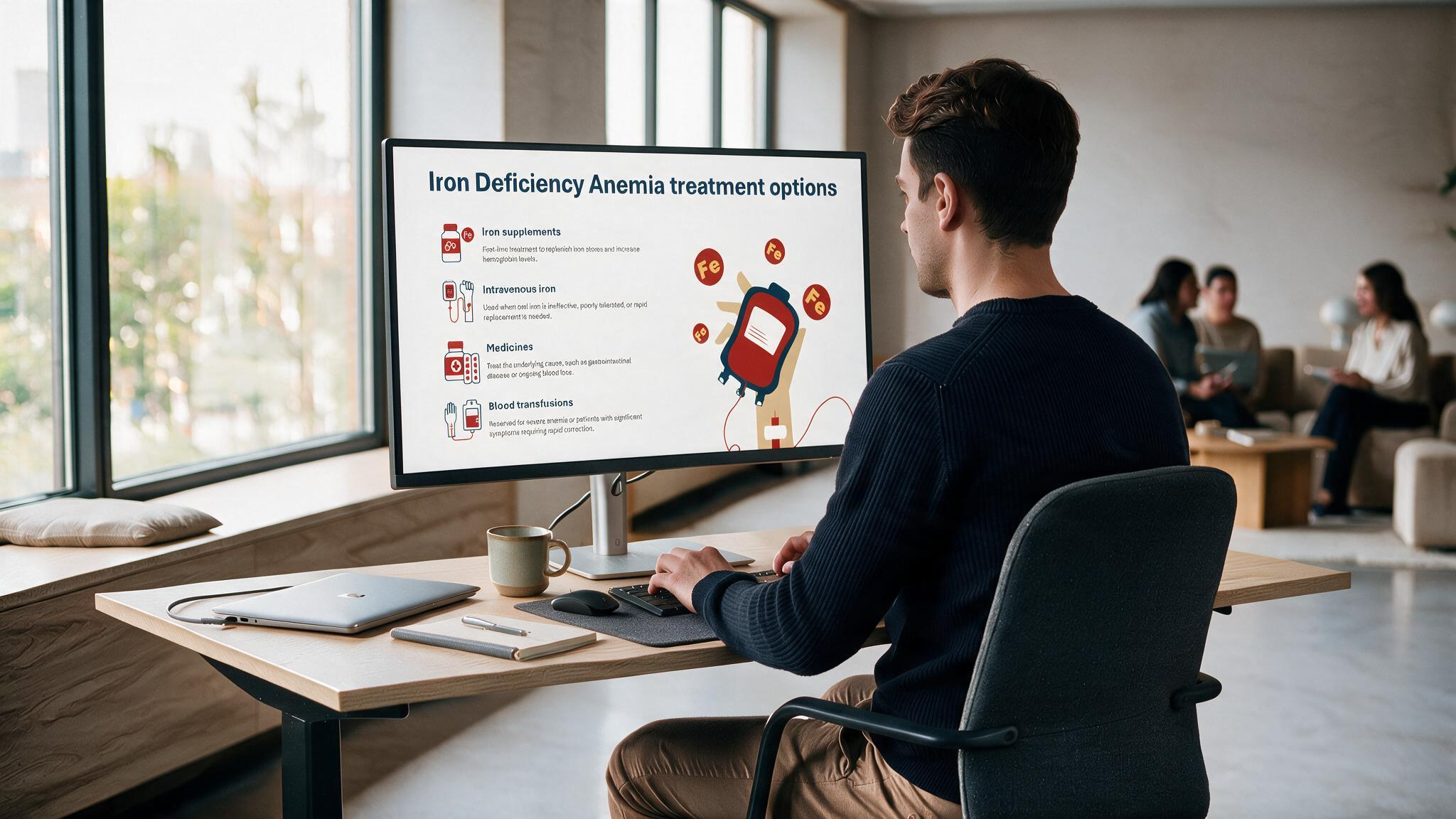
eLearning & SCORM Training Modules
Nursing and nutrition educators can customize this Iron Deficiency Anemia template with their own institutional screening protocols and patient case examples, then optionally convert the finished presentation into a SCORM-compliant module for students or clinical staff on an LMS. Left unedited, the 30-plus-slide template functions as a comprehensive clinical reference rather than a finished course. Because the iron-function, absorption, pathophysiology, and pregnancy-specific content already follows a teaching sequence, a customized version becomes certification-ready SCORM coursework without a separate instructional-design pass. If a program needs something more specific, the RxSlides team can adjust the template's depth or branding, or build a fully custom hematology presentation from scratch.
Medical & Healthcare Education
Hematology and nutrition faculty teaching iron metabolism can walk students through the ferric-to-ferrous absorption animation to establish the cellular mechanism before introducing pathology, instead of assembling reference diagrams from multiple sources. Continuing education providers preparing CME on anemia in pregnancy benefit from the same trimester-specific requirement and fetal-consequence content, instead of rebuilding maternal-health slides for every course. Patient educators adapting the prevention and dietary-source infographics for community sessions can simplify the same material while keeping the underlying physiology accurate. Students and patients alike leave with a clearer picture of how iron deficiency progresses from early depletion to clinical anemia.


The Anemia PowerPoint template opens with a cover slide before an infographic illustrates normal blood composition and RBC structure, followed by icons explaining iron's functions, its heme and non-heme forms, and daily intake requirements by age and gender. Animated illustrations then trace iron absorption in the small intestine and the erythropoiesis process that forms red blood cells in the bone marrow, illustrated in a set of editable medical diagrams.
A definition slide describes anemia and iron deficiency before an infographic visualizes prevalence on global and local levels with editable percentages and countries. Establishing this baseline first gives educators a shared reference point before medical icons cover risk factors, such as blood donation and family history, and causes, such as blood loss and poor diet, and three stages illustrate the condition's progression alongside its underlying pathophysiology.
Symptom icons cover cold hands, dizziness, headache, and extreme fatigue before blood test evaluation criteria, including decreased hemoglobin and increased TIBC, support diagnosis and differential diagnosis against conditions such as chronic disease anemia and lead poisoning. The medical presentation template closes this section with illustrated treatment options, oral iron supplements and blood transfusion, prognosis, complications, and preventive dietary guidance.
A dedicated section thoroughly covers iron deficiency anemia in pregnancy, including its prevalence, the importance of iron for energy and fetal development, and symptoms such as dizziness and shortness of breath. The presentation template details iron requirements by trimester, iron balance, fetal consequences like preterm delivery, complications, differential diagnosis, diagnosis, prophylaxis, and treatment with oral and IV iron.
Ready To Transform Your Presentation ?
Pay once, use forever