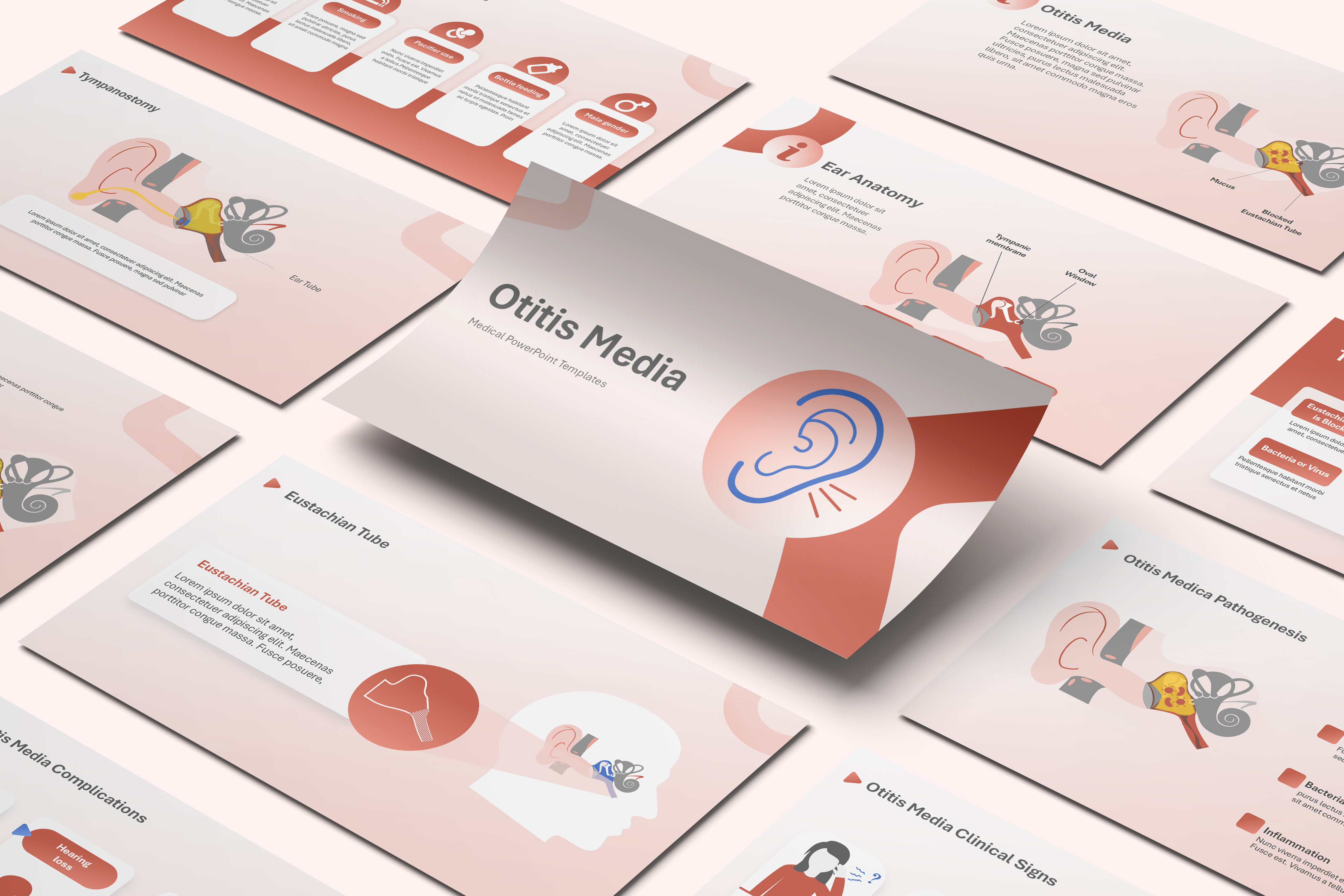
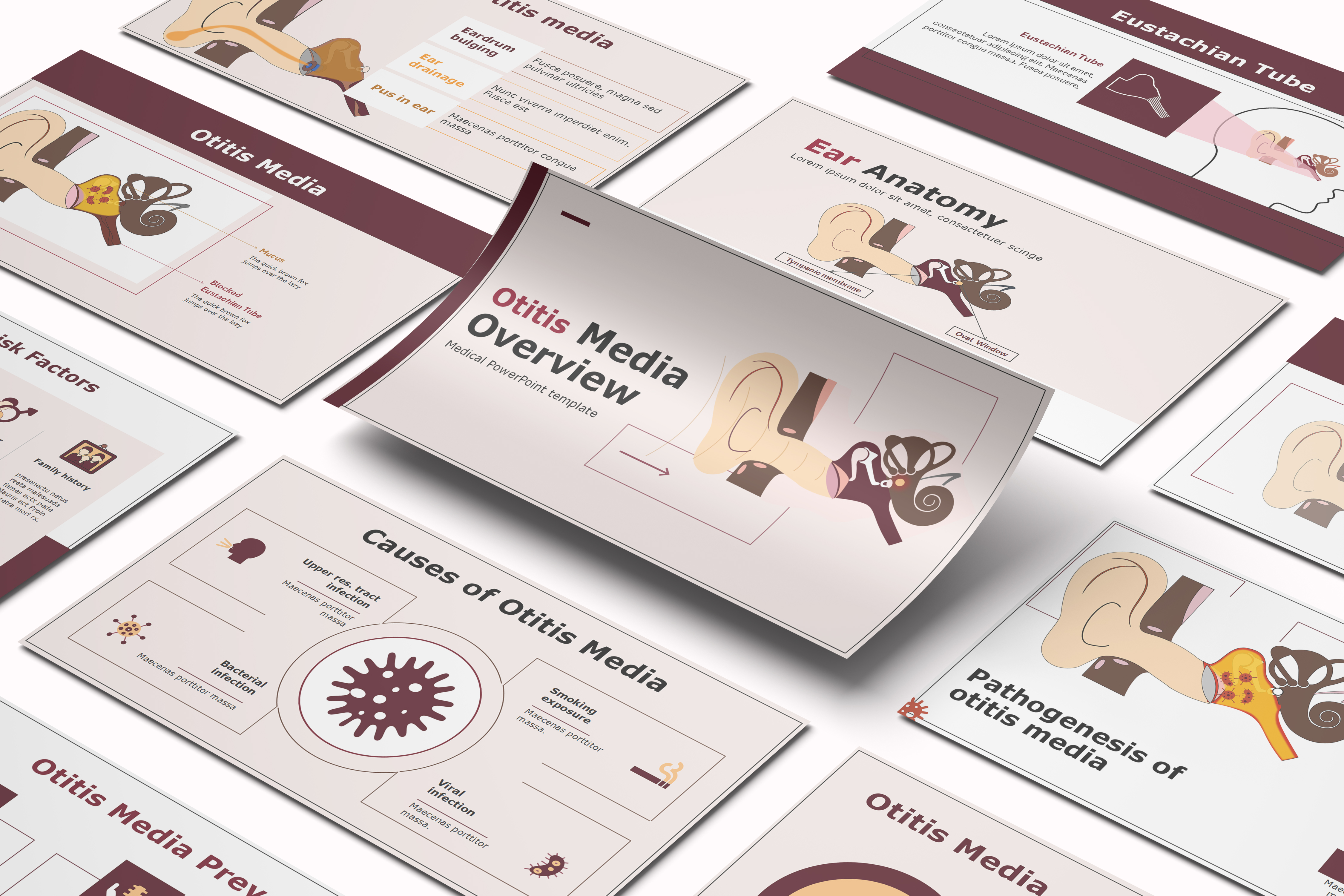
The design features a large, stylized illustration of the human ear in blue outline, with red sound/pain lines emanating from the inner part, symbolizing the condition.
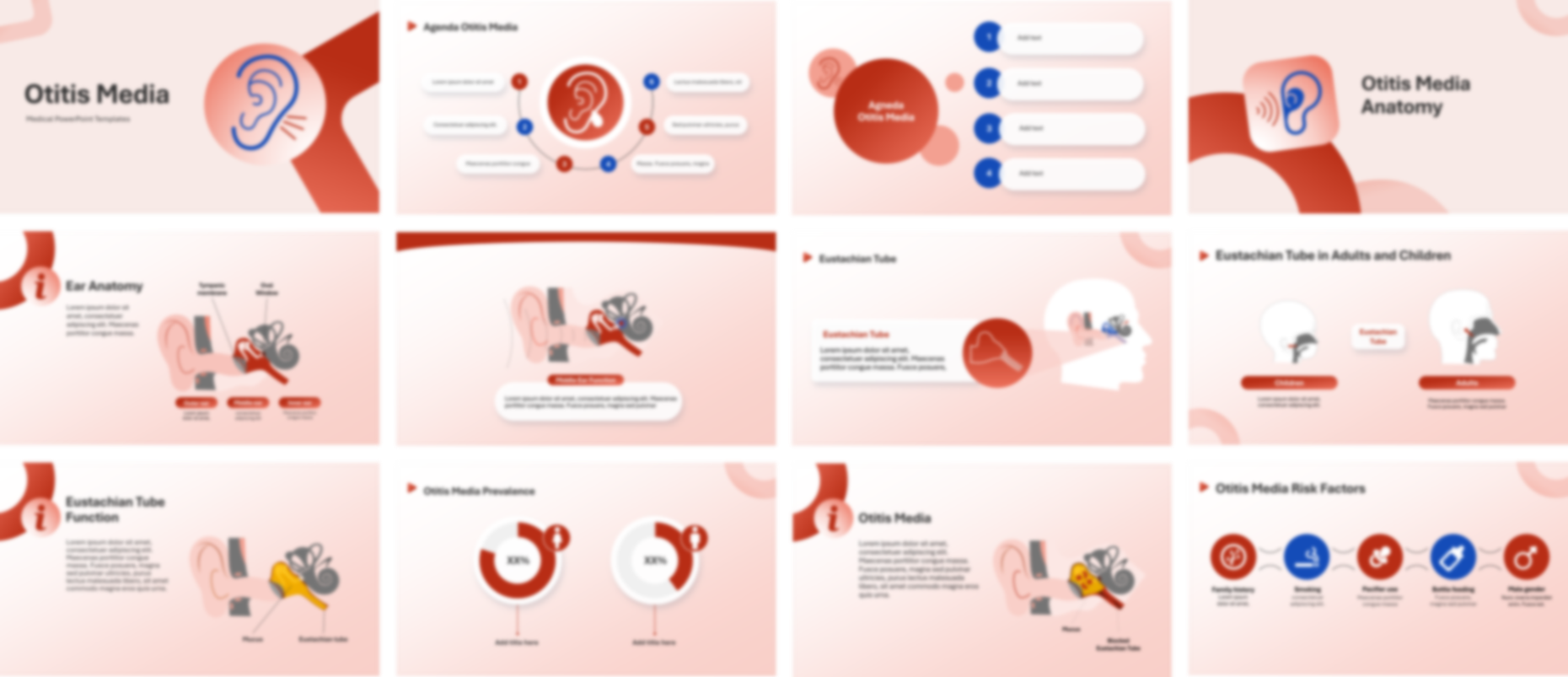
Slide 2 - Agenda Otitis Media (Six-Point Overview)
Agenda Otitis Media (Six-Point Overview)
Agenda slide or Table of Contents for the Otitis Media presentation.
The design uses a central red circular icon of the ear to focus the agenda points around the topic.
Six numbered points (1 through 6) are arranged around the central icon in a semi-circle flow, providing space for titles like "Definition," "Causes," "Symptoms," "Diagnosis," "Treatment," and "Prevention".
Slide 3 - Otitis Media Agenda (Four-Point Overview)
Otitis Media Agenda (Four-Point Overview)
This slide is an alternative Agenda or Key Takeaways page.
The design features a large central red circle displaying the title "Agneda Otitis Media" with a small ear icon to the left.
Four numbered, rounded, white text boxes (1 through 4) are arranged vertically to the right.
Slide 4 - Otitis Media Anatomy (Section Title)
Otitis Media Anatomy (Section Title)
Section divider slide to transmit to Anatomy relevant to Otitis Media.
The slide features a large, stylized blue ear icon on a pink, rounded-square shape, with red sound/pain lines.
The title "Otitis Media Anatomy" is prominent on the right.
The design uses a soft pink, red, and blue color scheme.
Slide 5 - Ear Anatomy (Structure Overview)
Ear Anatomy (Structure Overview)
Explains the major parts of the ear relevant to Otitis Media.
The slide features a large, detailed cross-section illustration of the ear, dividing it into three key sections: Outer ear, Middle ear (The location of Otitis Media), and Inner ear.
Key anatomical features are highlighted, including the Tympanic membrane (eardrum) and the Oval Window.
Slide 6 - Middle Ear Function (Focus on Pathophysiology)
Middle Ear Function (Focus on Pathophysiology)
Details the structure and function of the Middle Ear.
The slide features a large cross-section illustration of the Middle Ear on the top half. The illustration shows the tympanic membrane (eardrum) and the fluid-filled space containing the ossicles.
A prominent callout box at the bottom is titled "Middle Ear Function".
Slide 7 - Eustachian Tube (Anatomy and Function)
Eustachian Tube (Anatomy and Function)
Explains the Eustachian Tube, its location, and its critical role in draining the middle ear and equalizing pressure.
The slide features a simplified illustration of the human head and ear anatomy, with a zoomed-in section focusing on the Eustachian Tube.
Slide 8 - Eustachian Tube in Adults and Children (Key Difference)
Eustachian Tube in Adults and Children (Key Difference)
Illustrates the anatomical difference in the Eustachian Tube between Children and Adults.
The slide features two simplified side-profile illustrations of the head.
Slide 9 - Eustachian Tube Function (Detailed View)
Eustachian Tube Function (Detailed View)
Provides a more detailed look at the function of the Eustachian Tube.
The slide features a cross-section illustration highlighting the Eustachian Tube and its connection to the middle ear.
The illustration specifically labels the Eustachian tube and Mucus.
A key text box on the left, titled "Eustachian Tube Function,".
Slide 10 - Otitis Media Definition (Section Title)
Otitis Media Definition (Section Title)
Section divider slide to transmit to the Definition and potentially the Pathology of Otitis Media.
The slide features a large, stylized blue ear icon on a pink, rounded-square shape, with a single red drop beneath the ear, symbolizing fluid or inflammation.
The title "Otitis Media Definition" is prominent on the left.
Slide 11 - Otitis Media (Pathology Explained)
Otitis Media (Pathology Explained)
Illustrates the key pathological process in Otitis Media.
The slide features a prominent illustration of the ear's cross-section on the right.
The illustration clearly shows the middle ear space filled with a yellow fluid and labeled Mucus.
The Blocked Eustachian Tube is explicitly labeled.
Slide 12 - Otitis Media Prevalence (Section Title)
Otitis Media Prevalence (Section Title)
Section divider slide to transmit to Prevalence and Epidemiology of Otitis Media.
The slide features a large, stylized bar graph icon with a rising red arrow, visually representing statistics and increasing numbers.
The title "Otitis Media Prevalence" is prominent on the right.
Slide 13 - Otitis Media Prevalence (Gender Comparison)
Otitis Media Prevalence (Gender Comparison)
Compares the prevalence of Otitis Media between female and male populations.
The slide features two prominent doughnut charts side-by-side.
The left chart features a female icon (woman's head).
The right chart features a male icon (man's head).
Slide 14 - Otitis Media Risk factors (Section Title)
Otitis Media Risk factors (Section Title)
Section divider slide to transmit to the Risk Factors for Otitis Media.
The slide features a large, stylized blue and red caution/exclamation icon in a triangular shape.
The title "Otitis Media Risk factors" is prominent on the left.
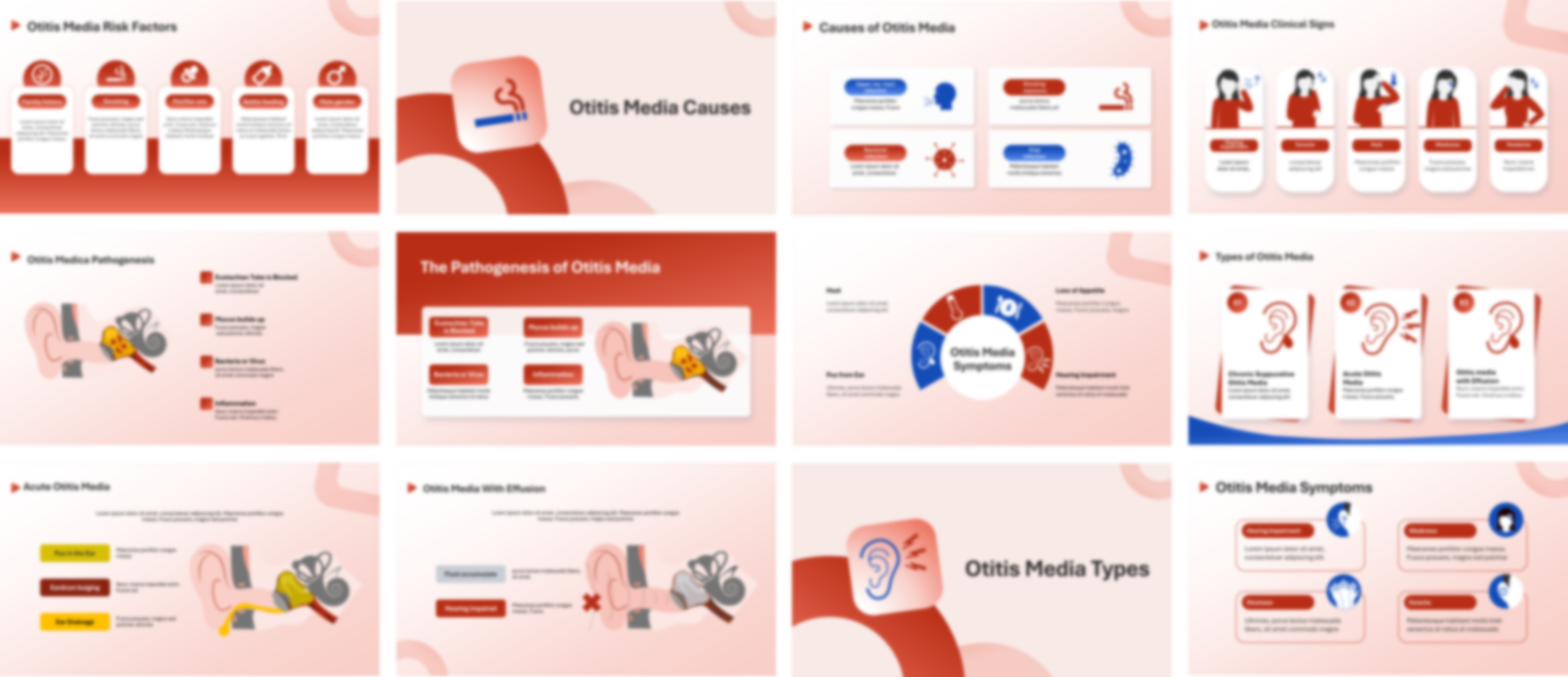
Slide 15 - Otitis Media Risk Factors (Five Key Factors)
Otitis Media Risk Factors (Five Key Factors)
Illustrates five key risk factors associated with developing Otitis Media.
The design uses a flow chart of five alternating red and blue circular icons connected by curved lines, showing the progression or relationship between risk factors: Family history, Smoking, Pacifier use, Bottle feeding, and Male gender.
Slide 16 - Otitis Media Risk Factors
Otitis Media Risk Factors
Describes five key risk factors associated with developing Otitis Media.
The design uses five vertical columns, each dedicated to a single risk factor and providing significant space for descriptive text beneath it.
Each column includes a prominent icon and title: Family history, Smoking, Pacifier use, Bottle feeding, and Male gender.
Slide 17 - Otitis Media Causes (Section Title)
Otitis Media Causes (Section Title)
Section divider slide to transmit to Causes of Otitis Media.
The slide features a large, stylized cigarette icon with smoke in a blue and red color scheme.
The title "Otitis Media Causes" is prominent on the right.
Slide 18 - Causes of Otitis Media
Causes of Otitis Media
Details the four main causes and contributing factors of Otitis Media.
The design uses layout visually separating the causes into four distinct boxes, each with its own icon and color scheme (red and blue): Upper res. tract infection, Smoking exposure, Bacterial infection, and Viral infection.
Slide 19 - Otitis Media Pathogenesis (Section Title)
Otitis Media Pathogenesis (Section Title)
Section divider slide to transmit to Pathogenesis (mechanism of disease) of Otitis Media.
The slide features a large, stylized icon showing multiple viral and bacterial pathogens in a blue and red color scheme.
The title "Otitis Media Pathogenesis" is prominent on the left.
Slide 20 - Otitis Media Pathogenesis (Four Steps)
Otitis Media Pathogenesis (Four Steps)
Explains the four steps in the development of Otitis Media.
The slide features a central illustration showing the ear anatomy with the middle ear space filled with yellow fluid.
Four key stages are listed vertically in red boxes on the right: Eustachian Tube is Blocked, Mucus builds up, Bacteria or Virus (Infection begins), and Inflammation.
Slide 21 - The Pathogenesis of Otitis Media
The Pathogenesis of Otitis Media
Segments the four steps in the development of Otitis Media.
The slide features a large illustration of the ear pathology on the right, showing the middle ear space filled with yellow, inflamed fluid and a blocked Eustachian tube.
The four key stages are presented in a 2x2 grid of contrasting red boxes on the left, offering separate description space for each step: Eustachian Tube is Blocked, Mucus builds up, Bacteria or Virus, and Inflammation.
Slide 22 - Otitis Media Types (Section Title)
Otitis Media Types (Section Title)
Section divider slide transmit to Types or classifications of Otitis Media.
The slide features a large, stylized blue ear icon with red sound/pain lines.
The title "Otitis Media Types" is prominent on the right.
The design uses a soft pink, red, and blue color scheme.
Slide 23 - Types of Otitis Media
Types of Otitis Media
Illustrates three primary types of Otitis Media.
The design uses three vertical cards, numbered 01, 02, and 03, each containing a relevant ear icon and a description of the type: Chronic Suppurative Otitis Media, Acute Otitis Media, and Otitis media with Effusion.
Slide 24 - Acute Otitis Media (Key Symptoms)
Acute Otitis Media (Key Symptoms)
Illustrates and explains the key clinical findings and symptoms specific to Acute Otitis Media (AOM).
The slide features a large illustration of the ear pathology on the right, specifically showing the middle ear space filled with fluid draining outwards.
Three key clinical features are highlighted in vertical, colorful boxes on the left: Pus in the Ear, Eardrum bulging, and Ear Drainage.
Slide 25 - Otitis Media With Effusion (OME)
Otitis Media With Effusion (OME)
Illustrates and explains the key clinical findings and consequences specific to Otitis Media with Effusion (OME).
The slide features a large illustration of the ear pathology on the right, showing the middle ear space filled with fluid but without the intense inflammation seen in AOM.
Two key clinical features are highlighted in vertical boxes on the left: Fluid accumulate and Hearing impaired.
Slide 26 - Otitis Media Symptoms (Section Title)
Otitis Media Symptoms (Section Title)
Section divider slide to transmit Symptoms of Otitis Media.
The slide features a large, stylized blue and red thermometer icon, visually representing fever, a common symptom of acute infection.
The title "Otitis Media Symptoms" is prominent on the left.
Slide 27 - Otitis Media Symptoms (Five Clinical Findings)
Otitis Media Symptoms (Five Clinical Findings)
Illustrates five key symptoms associated with Otitis Media.
The design uses a semi-circular arrangement of five content blocks surrounding a central title circle, creating an engaging visual flow: Heat, Loss of Appetite, Hearing Impairment, Pus from Ear, and a fifth point located at the top center with a thermometer icon.
Slide 28 - Otitis Media Symptoms (Detailed Breakdown)
Otitis Media Symptoms (Detailed Breakdown)
Details four specific symptoms that patients with Otitis Media may experience, including neurological and general effects.
The design uses a layout with four distinct content boxes, each containing an icon and a space for description: Hearing Impairment, Weakness, Dizziness, and Earache.
Slide 29 - Otitis Media Clinical Signs (Five Visual Findings)
Otitis Media Clinical Signs (Five Visual Findings)
Illustrates five clinical signs associated with Otitis Media.
The design uses five vertical cards, each featuring a simplified illustration of a woman demonstrating the specific symptom: Hearing Impairment, Earache, Heat, Weakness, and Headache.
Slide 30 - Otitis Media Diagnosis (Section Title)
Otitis Media Diagnosis (Section Title)
Section divider to transmit to the Diagnosis methods for Otitis Media.
The slide features a large, stylized blue and red medical device icon.
The title "Otitis Media Diagnosis" is prominent on the right.
The design uses a soft pink, red, and blue color scheme.
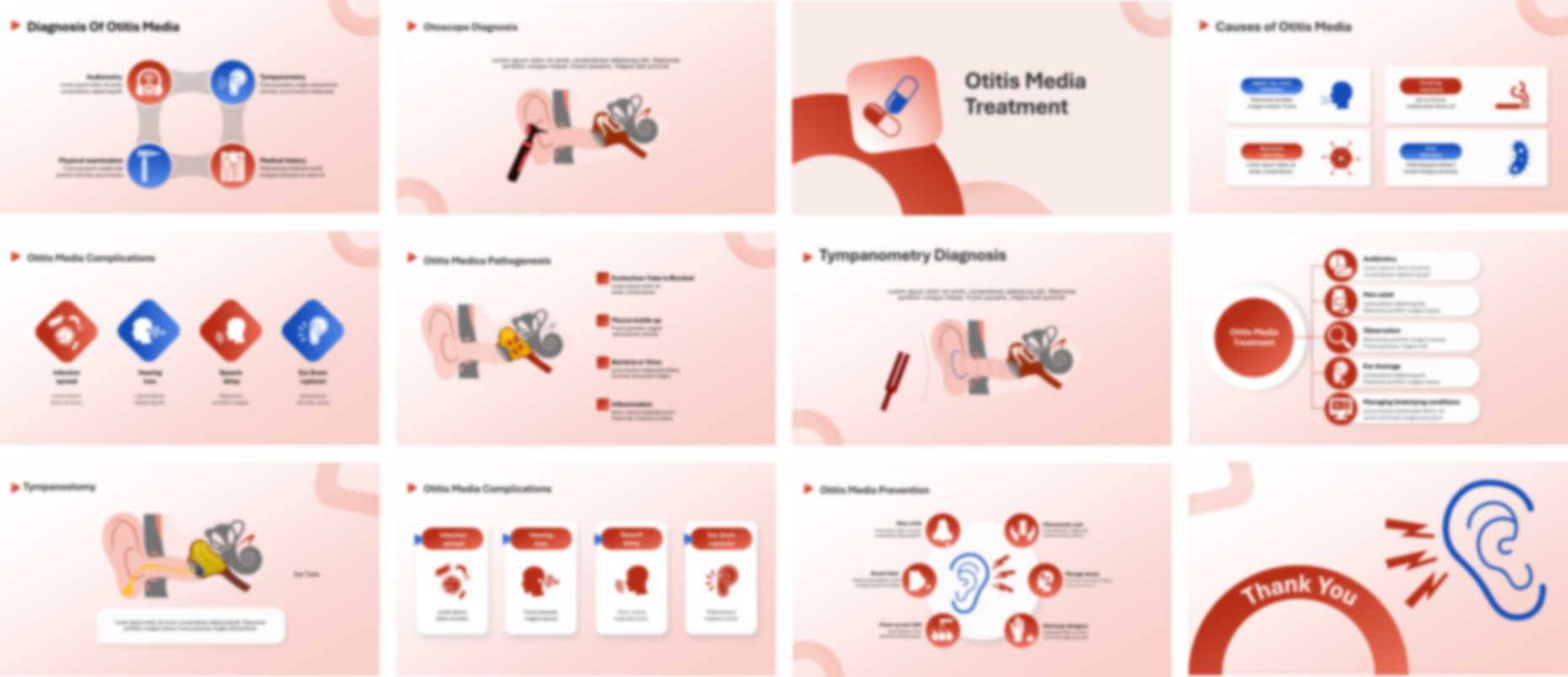
Slide 31 - Diagnosis Of Otitis Media (Four Methods)
Diagnosis Of Otitis Media (Four Methods)
Illustrates four methods used in the clinical diagnosis of Otitis Media.
The design uses a circular flow chart with four connected content blocks: Audiometry, Tympanometry, Medical history, and Physical examination.
Illustrates the role of the Otoscope in the physical examination component of Otitis Media diagnosis.
The slide features a large illustration showing the external, middle, and inner ear, with an Otoscope inserted into the ear canal.
Slide 33 - Tympanometry Diagnosis (Assessment of Middle Ear)
Tympanometry Diagnosis (Assessment of Middle Ear)
Illustrates the role of Tympanometry in the diagnosis of Otitis Media.
The slide features a large illustration showing the ear anatomy with a tuning fork near the ear canal.
The illustration specifically highlights the middle ear and ossicles.
Slide 34 - Otitis Media Complications (Section Title)
Otitis Media Complications (Section Title)
Section divider slide to transmit to the Complications associated with Otitis Media.
The slide features a large, stylized blue and red emergency siren/light icon.
The title "Otitis Media Complications" is prominent on the left.
Slide 35 - Otitis Media Complications (Four Key Issues)
Otitis Media Complications (Four Key Issues)
Illustrates four complications.
The design uses a row of four diamond-shaped icons in contrasting red and blue, each with a brief description beneath: Infection spread, Hearing loss, Speech delay, and Ear Drum ruptures.
Slide 36 - Otitis Media Complications (Alternative Detailed View)
Otitis Media Complications (Alternative Detailed View)
An alternative to Slide 35.
Slide 37 - Otitis Media Treatment (Section Title)
Otitis Media Treatment (Section Title)
Section divider slide to transmit to Treatment options for Otitis Media.
The slide features a large, stylized blue and red capsule/pill icon.
The title "Otitis Media Treatment" is prominent on the right.
The design uses a soft pink, red, and blue color scheme.
Slide 38 - Otitis Media Treatment (Five Key Strategies)
Otitis Media Treatment (Five Key Strategies)
Details five key management strategies for treating Otitis Media.
The design uses a visual list, where a central red circle containing the title is connected to five vertical cards, each describing a treatment method: Antibiotics, Pain relief, Observation, Ear drainage, and Managing Underlying conditions.
Slide 39 - Tympanostomy (Surgical Treatment)
Tympanostomy (Surgical Treatment)
Illustrates and explains the surgical procedure known as Tympanostomy.
The slide features a large illustration showing the ear anatomy with a small tube inserted through the Tympanic Membrane into the middle ear space.
The tube is labeled "Ear Tube" and is positioned to help drain the fluid and ventilate the middle ear, which is otherwise blocked by infection.
Slide 40 - Otitis Media Prevention (Section Title)
Otitis Media Prevention (Section Title)
Section divider slide to transmit to Prevention strategies for Otitis Media.
The slide features a large, stylized icon of two hands cradling a spine/bone structure.
The title "Otitis Media Prevention" is prominent on the left.
Slide 41 - Otitis Media Prevention (Six Strategies)
Otitis Media Prevention (Six Strategies)
Illustrates six strategies for preventing or reducing the risk of Otitis Media.
The design uses a radial flow chart of six red circular icons surrounding a central blue ear icon, creating a comprehensive overview of protective measures: Stop colds, Chiropractic care, Manage stress, Eliminate allergens, Clean up your diet, and Breast feed.
Slide 42 - Thank You (Conclusion)
Thank You (Conclusion)
Concludes the presentation on Otitis Media.
The slide features a large, central blue ear outline with red sound/pain lines radiating from it.
The phrase "Thank You" is displayed in white text within a bold.
Features of the Template
- 100% editable PowerPoint template. - Editable colors, you can change according to your presentation style and company branding guidelines.
Purchase Template
Purchase the fully editable PowerPoint open file template