Rheumatic Heart Disease Presentation Template




Template Preview
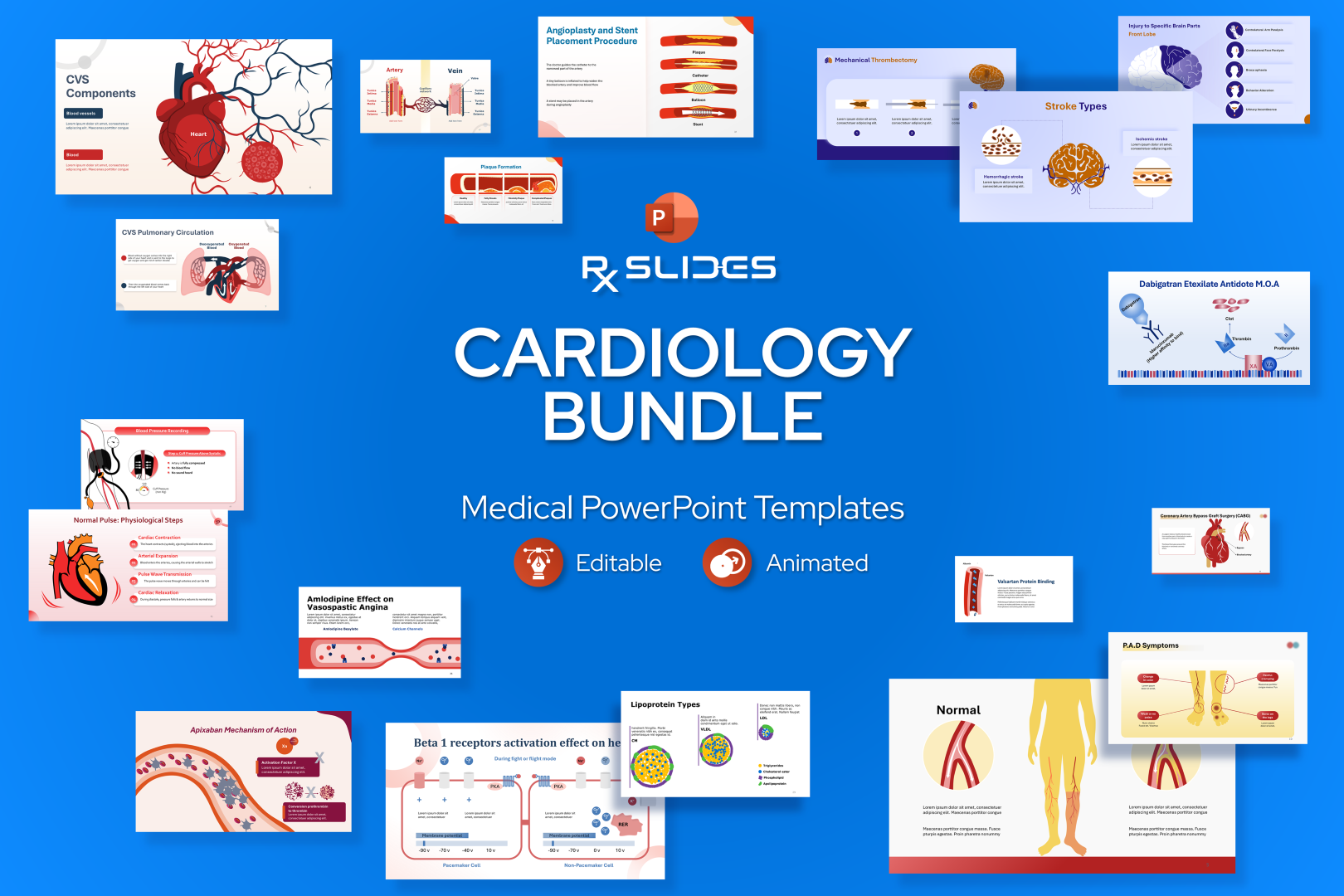
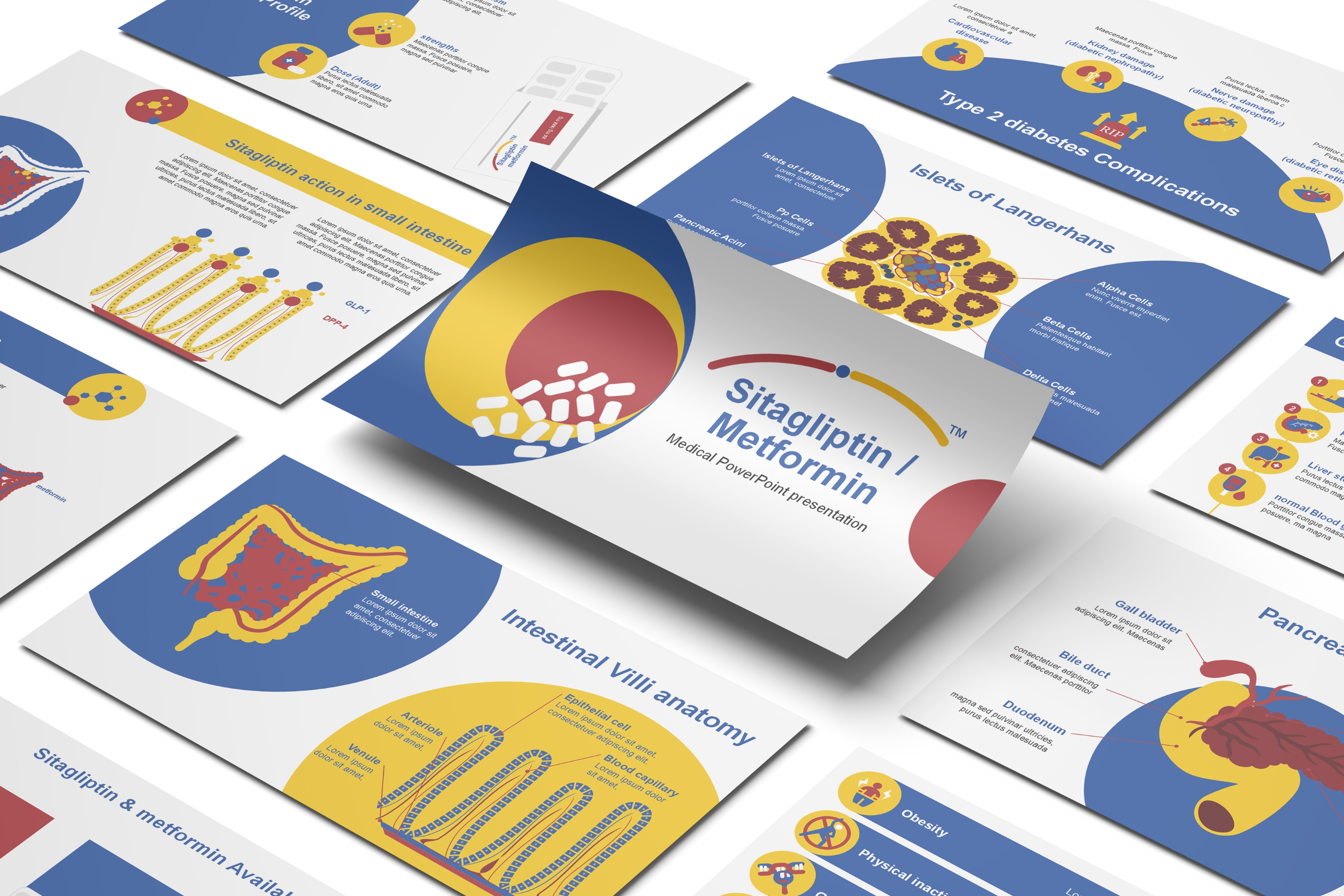
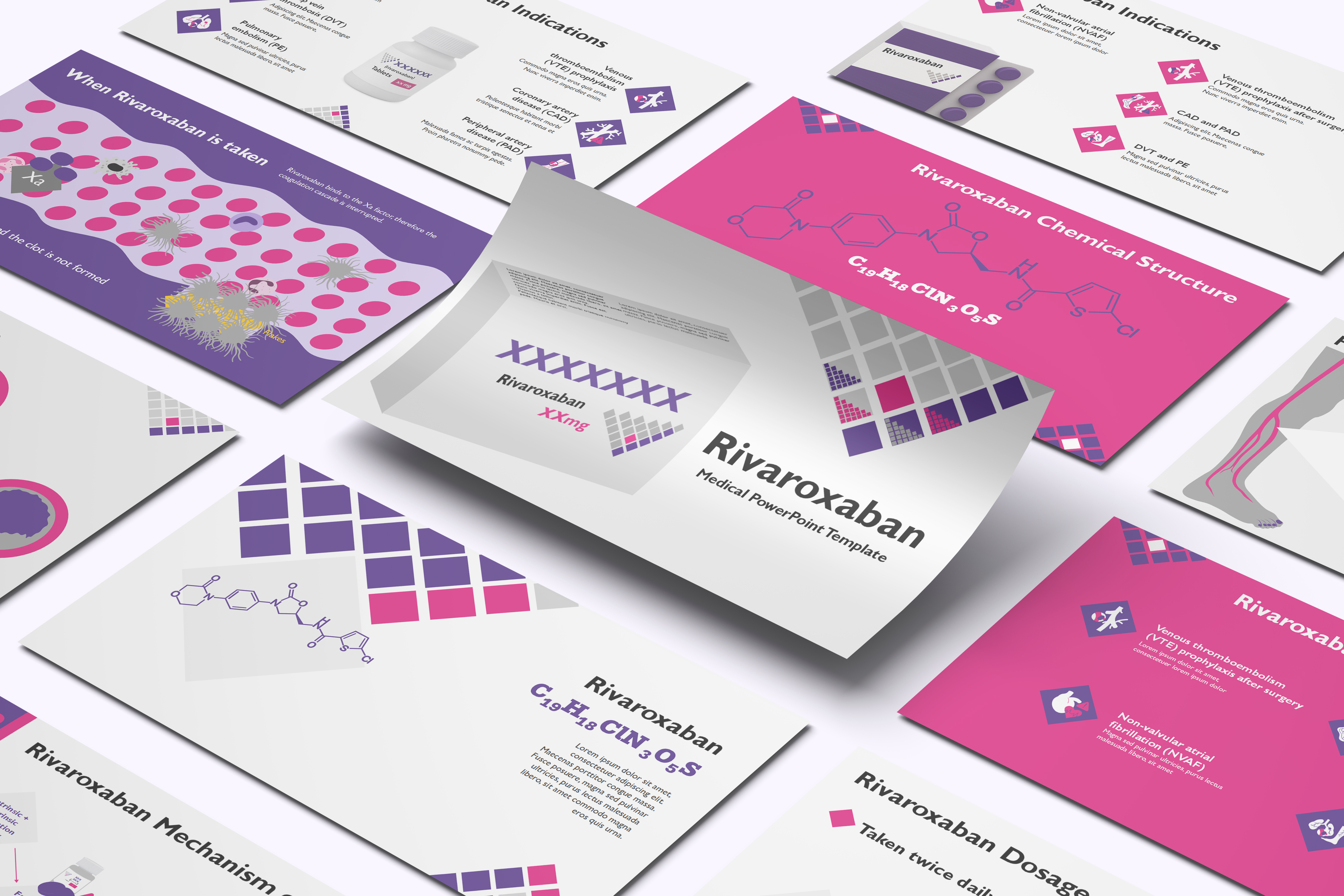
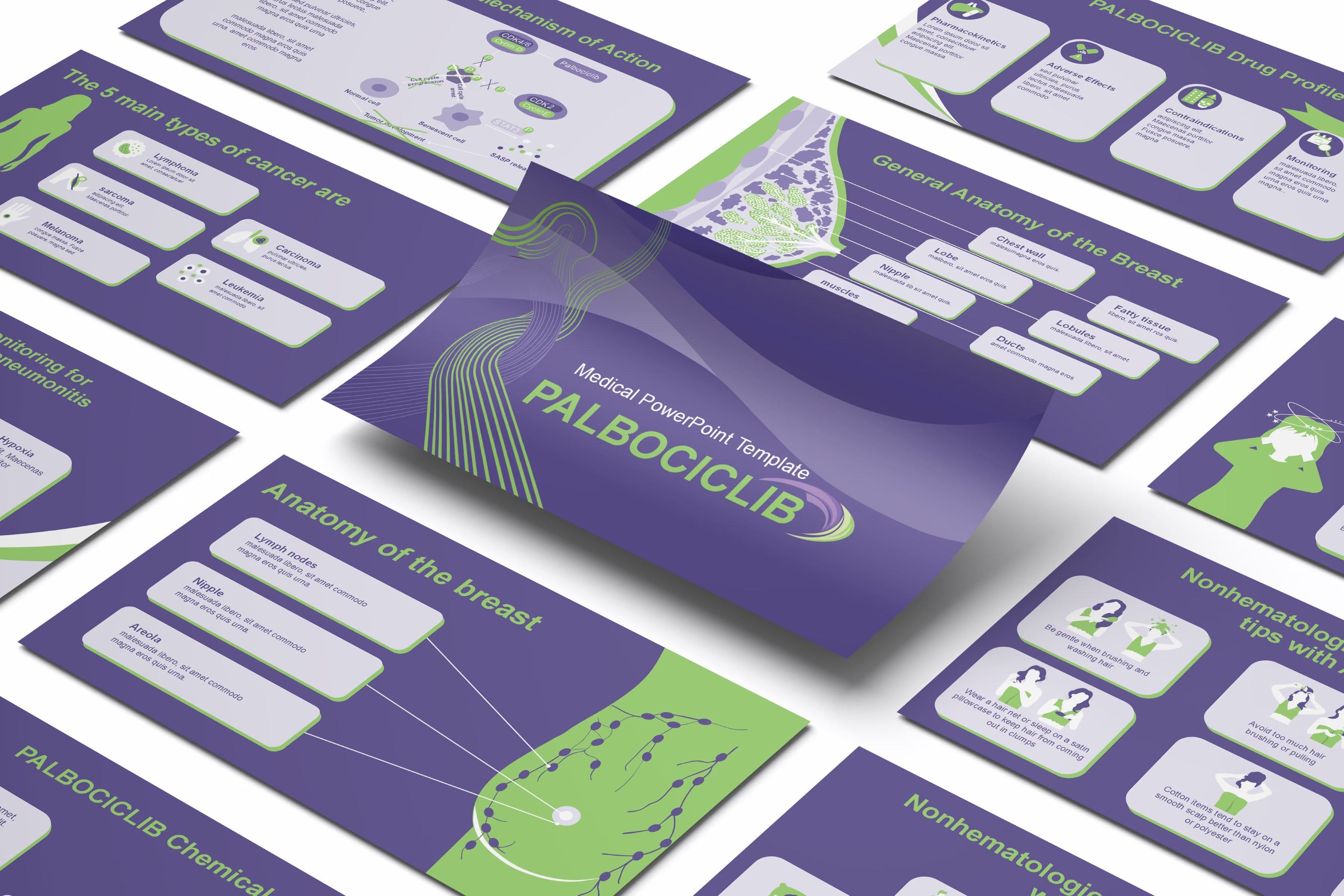
Designed for healthcare professionals creating clear and structured medical presentations.
Ideal for doctors, medical educators, and pharmaceutical teams preparing lectures, clinical education, product presentations, and training.
Fully editable in PowerPoint, allowing you to customize diagrams, charts, and slide layouts with your own medical content
Ready-to-use presentation structure that saves time and helps you build professional healthcare presentations quickly.
Fully Animated
Built-in animations help you present medical information clearly and make complex concepts easier to understand.
Editable Colors and Shapes
Editable colors and shapes help you easily customize the slides to match your content and presentation style, just drag and drop your content.
Professional medical layouts
Professional medical layouts help you organize clinical information, medical data, and treatment insights in a clear and structured way.

Created by Medical Professionals
This template prioritizes medical accuracy, clarity, and real-world usability. Each slide is designed with a medical audience in mind, helping you present clinical information, data, and treatment insights in a way that is structured, credible, and easy for healthcare professionals to understand.
Medical Training for Pharmaceutical & Life Sciences Companies
Medical Affairs and Training teams building cardiology onboarding content can use this Rheumatic Heart Disease template to trace the full disease arc, from Group A Streptococcal pharyngitis and the molecular-mimicry autoimmune mechanism through valvular scarring and long-term heart failure. New cardiology sales trainees and Medical Science Liaisons get a structured introduction to the Jones Criteria, echocardiographic diagnosis, and treatment approaches spanning penicillin prophylaxis, antibiotics, and valve replacement surgery. Because the template separates pathogenesis, diagnosis, and management into distinct sections, trainers can adapt session depth to their own onboarding schedule. New hires finish training able to connect a strep infection in childhood to the valvular disease a cardiologist may see decades later.

Medical Congress & Scientific Conference Presentations
Cardiologists, pediatric cardiologists, and internal medicine physicians preparing a conference session on rheumatic heart disease can adapt this template's molecular-mimicry pathogenesis sequence rather than rebuilding the strep-to-valve-damage narrative for each talk. The global burden slide, noting that 80 to 85 percent of cases occur in low- and middle-income countries, gives a speaker a ready framework for discussing healthcare access alongside the clinical pathology. Diagnostic content covering the Jones Criteria and echocardiography supports a technically detailed session for a specialist audience, while the myth-busting slides help a presenter address common misconceptions during a public health or CME talk. A Key Opinion Leader speaking at multiple cardiology meetings can reuse the illustrations across sessions of varying depth.

Pharmaceutical Product & Medical Affairs Presentations
Medical Affairs teams supporting a cardiovascular or antibiotic prophylaxis product can use this Rheumatic Heart Disease presentation as disease-state groundwork for scientific exchange, covering the autoimmune pathogenesis, valvular damage mechanism, and the clinical rationale behind long-term penicillin prophylaxis without referencing a specific brand. Medical Science Liaisons can present the customized material during advisory boards or KOL discussions to build shared understanding of RHD's disease course before introducing any product-specific data. Because the content stays disease-focused, it gives Medical Affairs a starting point still subject to the customer's own medical and compliance review before field use. Cardiology and public health teams gain a consistent scientific reference for a condition closely tied to healthcare access and prevention.
eLearning & SCORM Training Modules
Learning & Development teams training new cardiology fellows or public health outreach staff can customize this Rheumatic Heart Disease template with institution-specific screening protocols, then convert the finished presentation into a SCORM-compliant module for their learning management system when self-paced training suits a program better. The molecular-mimicry pathogenesis sequence and valve-damage illustrations translate naturally into interactive checkpoints within an e-learning course on cardiology or global health. When a program needs a narrower scope, such as prevention and prophylaxis alone, or a different depth for nursing versus physician learners, the RxSlides team can adjust the template's coverage and branding. If none of the existing templates cover the specific training need, the RxSlides team can build a fully custom presentation from scratch instead.
Medical & Healthcare Education
Medical and nursing faculty teaching cardiology or infectious disease can use this template's heart anatomy and molecular-mimicry illustrations to establish how a streptococcal throat infection leads to chronic valve disease, without assembling the pathogenesis sequence from separate sources. The myth-busting slides give instructors a ready tool for correcting common student misconceptions, such as the belief that RHD only affects adults or is a rare condition. Diagnostic content covering the Jones Criteria and echocardiography connects the underlying pathology to the clinical workup students will encounter on cardiology rotations. Students leave with a clear understanding of RHD as a preventable disease tied closely to healthcare access and early strep treatment.


The Rheumatic Heart Disease Presentation Template opens with a labeled anatomical diagram identifying the aorta, pulmonary artery, atria, ventricles, and all four heart valves to establish a structural baseline. A microbiological profile then details Streptococcus pyogenes as the causative agent, highlighting its Gram positive, non-motile, catalase negative structure alongside virulence factors such as its protective capsule and adhesive M protein in a set of editable medical illustrations.
The template traces the autoimmune mechanism from streptococcal infection to molecular mimicry, showing how antibodies against bacterial M protein mistakenly target human heart tissue. Establishing this mechanism first gives educators a shared reference point before a data driven map visualizes the global burden, noting that 80 to 85 percent of cases occur in low to middle income countries.
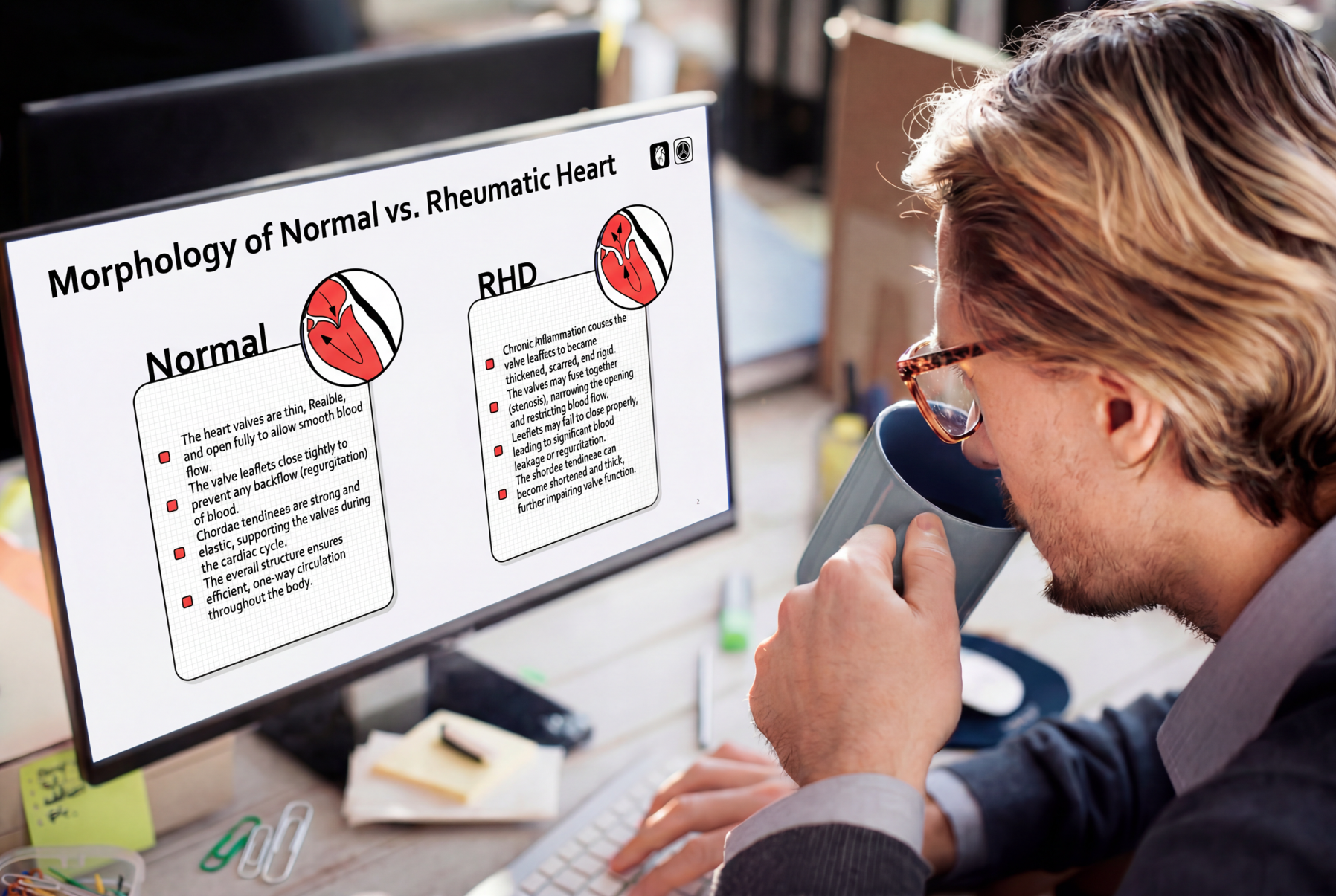
Illustrations detail the physical damage caused by rheumatic carditis, including scar formation, leaflet thickening, and commissural fusion. A comparison slide then contrasts a normal valve against one affected by chronic aortic regurgitation to help visualize the resulting hemodynamic failure.
Icon based slides outline symptoms including fatigue, fever, chest pain, and subcutaneous nodules before a diagnostic roadmap covers echocardiogram, x-ray, electrocardiogram, and MRI. The presentation template closes with three treatment approaches, surgery, antibiotics, and lifelong prophylaxis, alongside prevention strategies centered on benzathine penicillin injections and early detection, presented in a set of editable medical diagrams.
Ready To Transform Your Presentation ?
Pay once, use forever