Rosacea PowerPoint Template





Template Preview
Designed for healthcare professionals creating clear and structured medical presentations.
Ideal for doctors, medical educators, and pharmaceutical teams preparing lectures, clinical education, product presentations, and training.
Fully editable in PowerPoint, allowing you to customize diagrams, charts, and slide layouts with your own medical content
Ready-to-use presentation structure that saves time and helps you build professional healthcare presentations quickly.
Fully Animated
Built-in animations help you present medical information clearly and make complex concepts easier to understand.
Editable Colors and Shapes
Editable colors and shapes help you easily customize the slides to match your content and presentation style, just drag and drop your content.
Professional medical layouts
Professional medical layouts help you organize clinical information, medical data, and treatment insights in a clear and structured way.

Created by Medical Professionals
This template prioritizes medical accuracy, clarity, and real-world usability. Each slide is designed with a medical audience in mind, helping you present clinical information, data, and treatment insights in a way that is structured, credible, and easy for healthcare professionals to understand.
Medical Training for Pharmaceutical & Life Sciences Companies
Medical Affairs and Training teams building dermatology onboarding content can use this animated Rosacea template to walk new hires through skin anatomy, the Cathelicidin-protein mechanism behind facial redness and blood vessel dilation, and the four clinical subtypes: erythematotelangiectatic, papulopustular, phymatous, and ocular rosacea. New dermatology sales trainees and Medical Science Liaisons get a visual reference for treatment classes including topical metronidazole, azelaic acid, oral doxycycline, and laser therapy. Because the template separates causes, risk factors, symptoms, and treatment into distinct sections, trainers can adapt individual modules to their own onboarding timeline. New hires finish training able to distinguish rosacea subtypes and explain the underlying vascular mechanism driving each.

Medical Congress & Scientific Conference Presentations
Dermatologists and primary care physicians preparing a conference session or grand rounds talk on rosacea can adapt this animated template's Cathelicidin pathophysiology sequence rather than rebuilding facial vascular illustrations for each presentation. The four-subtype comparison gives a speaker a ready framework for a case-based discussion distinguishing erythematotelangiectatic from papulopustular or phymatous presentations. Diagnostic and treatment content, including Demodex mite involvement and laser therapy options, supports a technically detailed session for a specialist audience while remaining accessible to a primary care crowd. A Key Opinion Leader presenting at multiple dermatology meetings can reuse the animated illustrations across sessions of varying depth.

Pharmaceutical Product & Medical Affairs Presentations
Medical Affairs teams supporting a topical or oral rosacea therapy can use this animated presentation as disease-state groundwork for scientific exchange, covering the Cathelicidin-driven vascular mechanism, the four clinical subtypes, and known triggers such as sunlight and alcohol without referencing a specific brand. Medical Science Liaisons can present the customized material during advisory boards or KOL discussions to build shared clinical understanding before any product-specific efficacy data is introduced. The disease-focused framing keeps the presentation a flexible starting point, one that still passes through the customer's own medical and compliance review before field use. Dermatology teams gain a consistent, animated scientific reference across multiple therapeutic conversations.

eLearning & SCORM Training Modules
Learning & Development teams training new dermatology residents or aesthetic clinic staff can customize this animated Rosacea template with institution-specific protocols, then convert the finished presentation into a SCORM-compliant module for their learning management system when self-paced training suits the program better. The pathophysiology and subtype-comparison slides translate naturally into interactive checkpoints within an e-learning course on dermatologic disease. When a program needs a narrower scope, such as diagnosis and subtype differentiation alone, or a different depth for PA versus resident learners, the RxSlides team can adjust the template's coverage and branding. For a training need that no current template covers, a fully custom presentation can be designed from scratch instead.
Medical & Healthcare Education
Medical and PA program faculty teaching dermatology can use this animated template's skin-anatomy and Cathelicidin-mechanism illustrations to explain rosacea's vascular basis without assembling pathophysiology diagrams independently. The four-subtype comparison gives students a clear framework for a differential diagnosis that is frequently confused early in training, particularly between erythematotelangiectatic and papulopustular presentations. Diagnostic content covering dermoscopy and skin biopsy connects the underlying pathology to procedures students will observe during dermatology rotations. Faculty can extend the same slide set into case-based discussion sections on inflammatory skin disease.
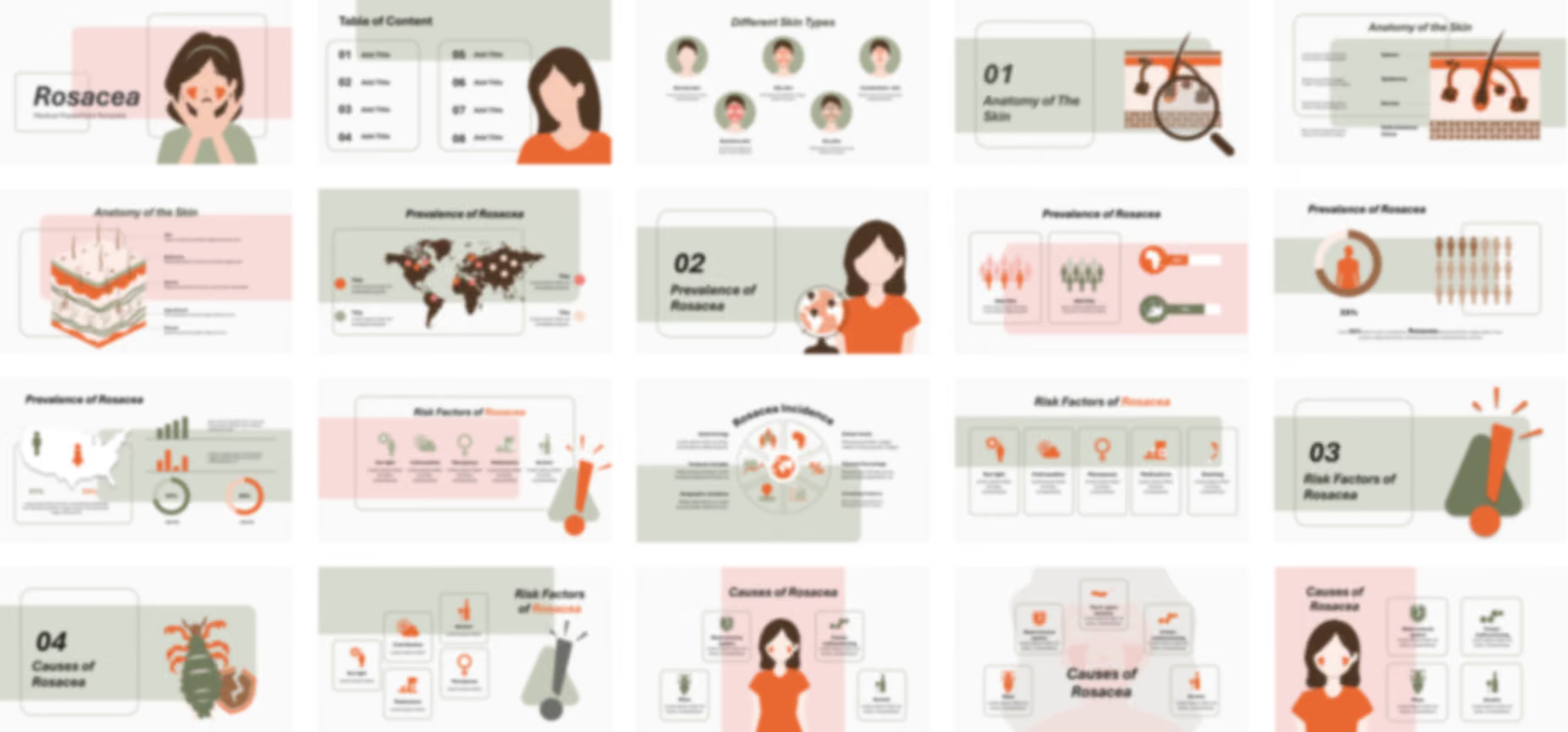
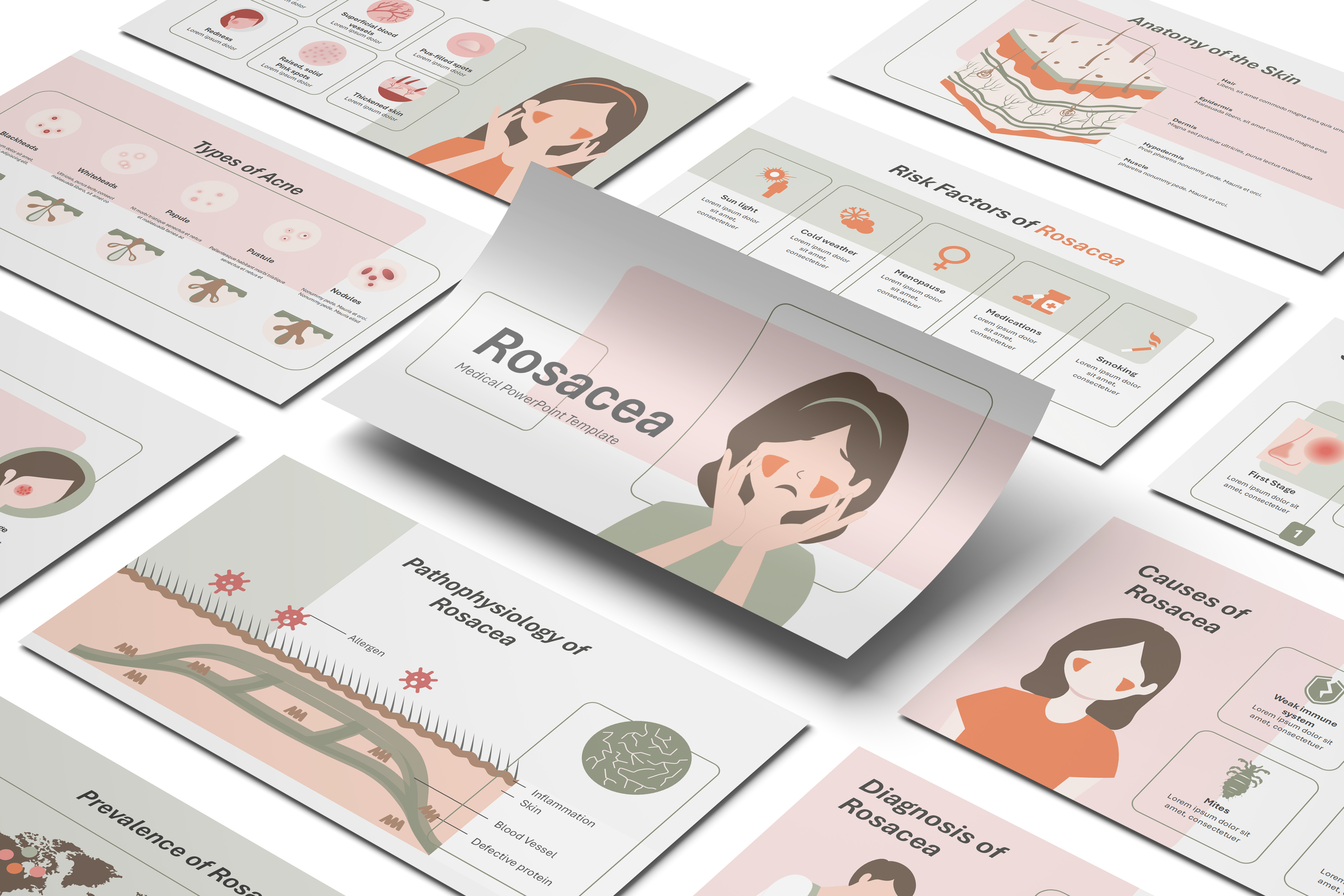
The Rosacea PowerPoint template opens with cover slides before a sectional illustration details the skin's layers, including the epidermis, dermis, and subcutaneous tissue, in a set of editable medical diagrams. An infographic with changeable percentages then visualizes the epidemiology of rosacea on global and local levels, noting that women are diagnosed more often than men.
Medical icons illustrate the most common risk factors, including sunlight, cold weather, vigorous exercise, menopause, medicines, and alcohol. Further icons then cover causes such as a weak immune system, Demodex mites, H. pylori bacteria, and protein malfunctioning.
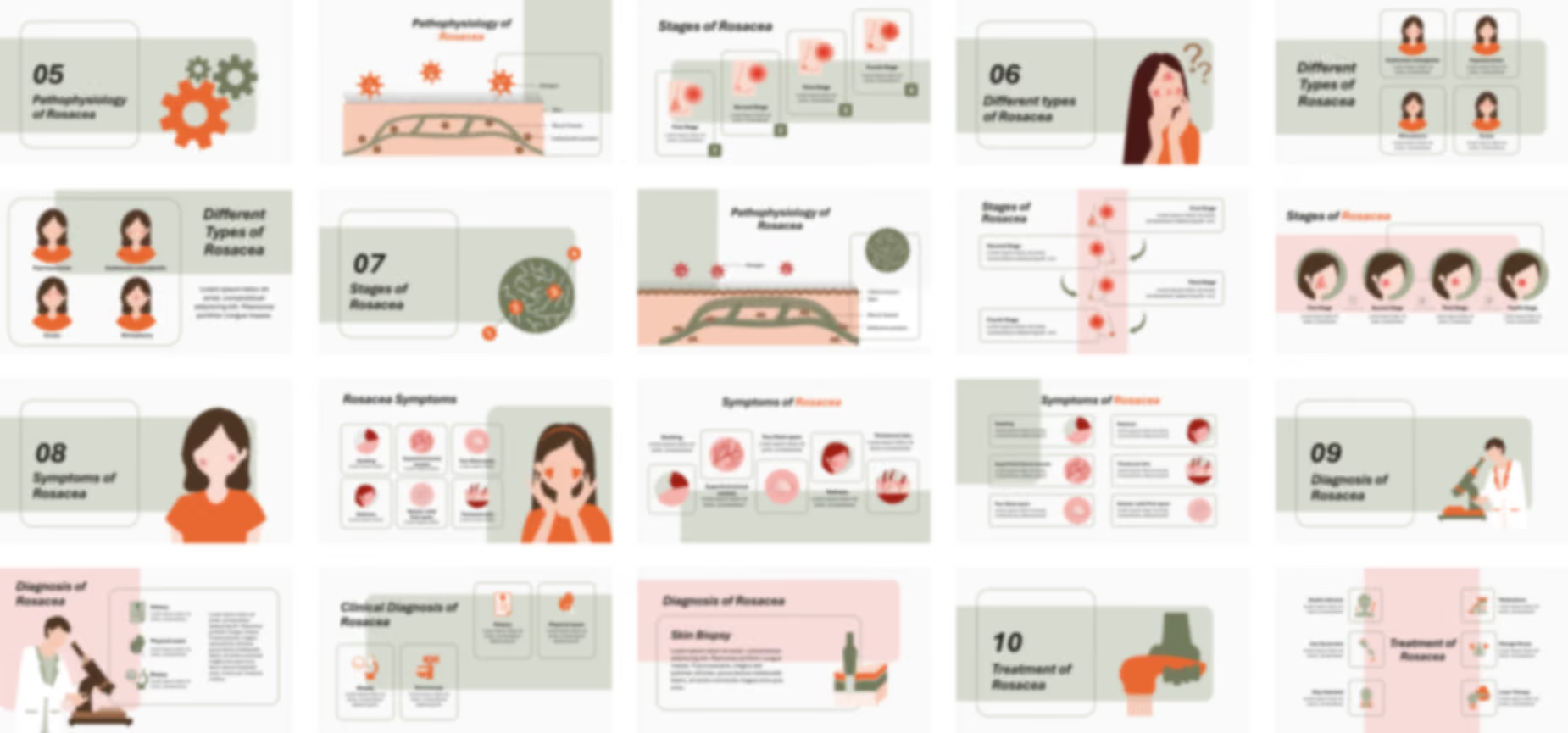
An animated illustration explains the pathophysiology of rosacea, showing how a malformed cathelicidin protein loses its ability to control blood flow, causing blood vessels to expand and skin bacteria to activate the immune system into inflammatory mode. Establishing this mechanism first gives educators a shared reference point before medical illustrations classify the disease into four types, erythemato telangiectatic, papulopustular, rhinophyma, and ocular rosacea.
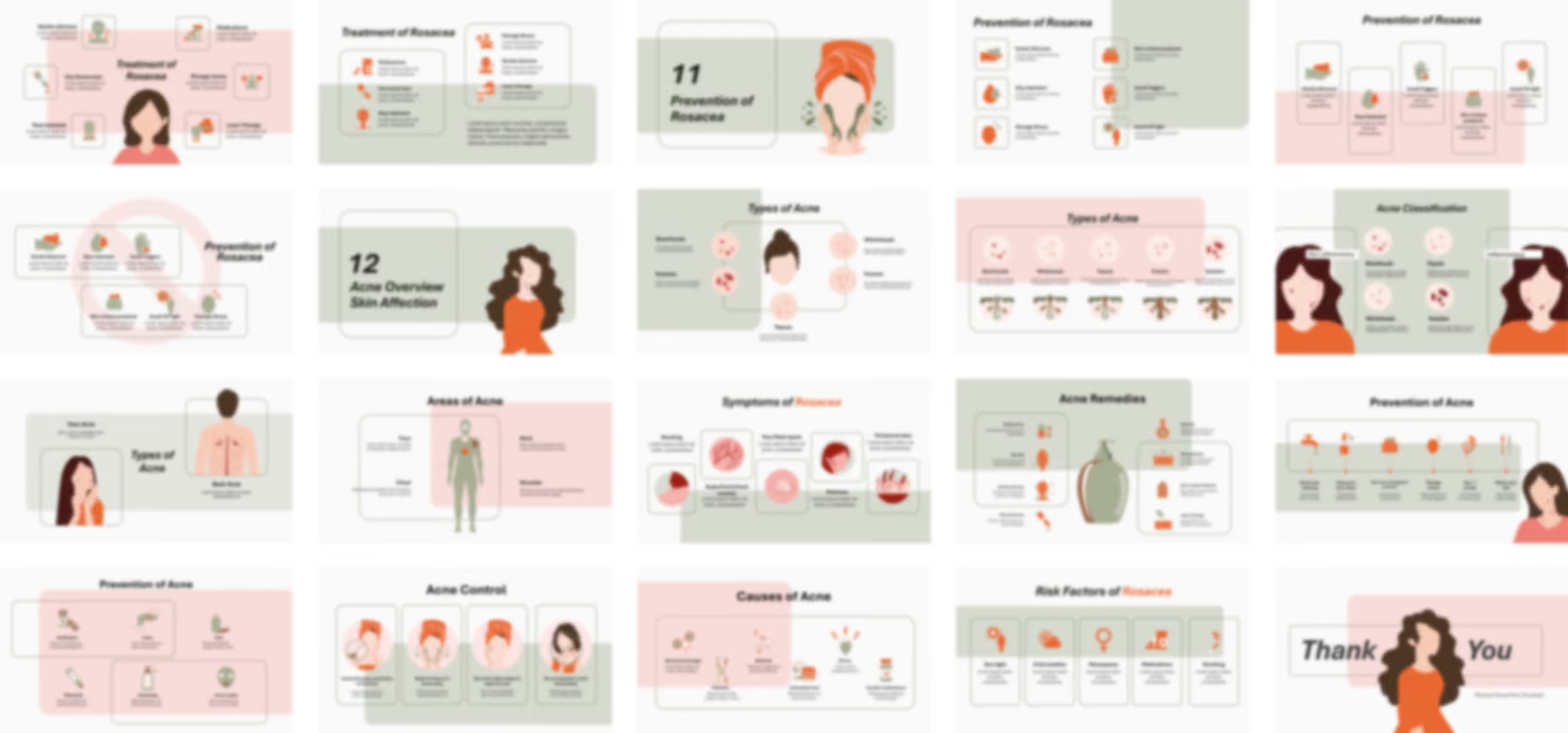
Illustrations describe the disease's four stages before medical illustrations depict symptoms including swelling, superficial blood vessels, redness, pus filled spots, rhinophyma, and thickened skin. The presentation template closes with diagnostic methods including dermoscopy, physical examination, and skin biopsy, treatment options such as skincare, laser and light therapies, and oral medications, and preventive measures including trigger avoidance and sun protection, illustrated in a set of editable medical icons and illustrations.
Ready To Transform Your Presentation ?
Pay once, use forever