Stroke PowerPoint Template

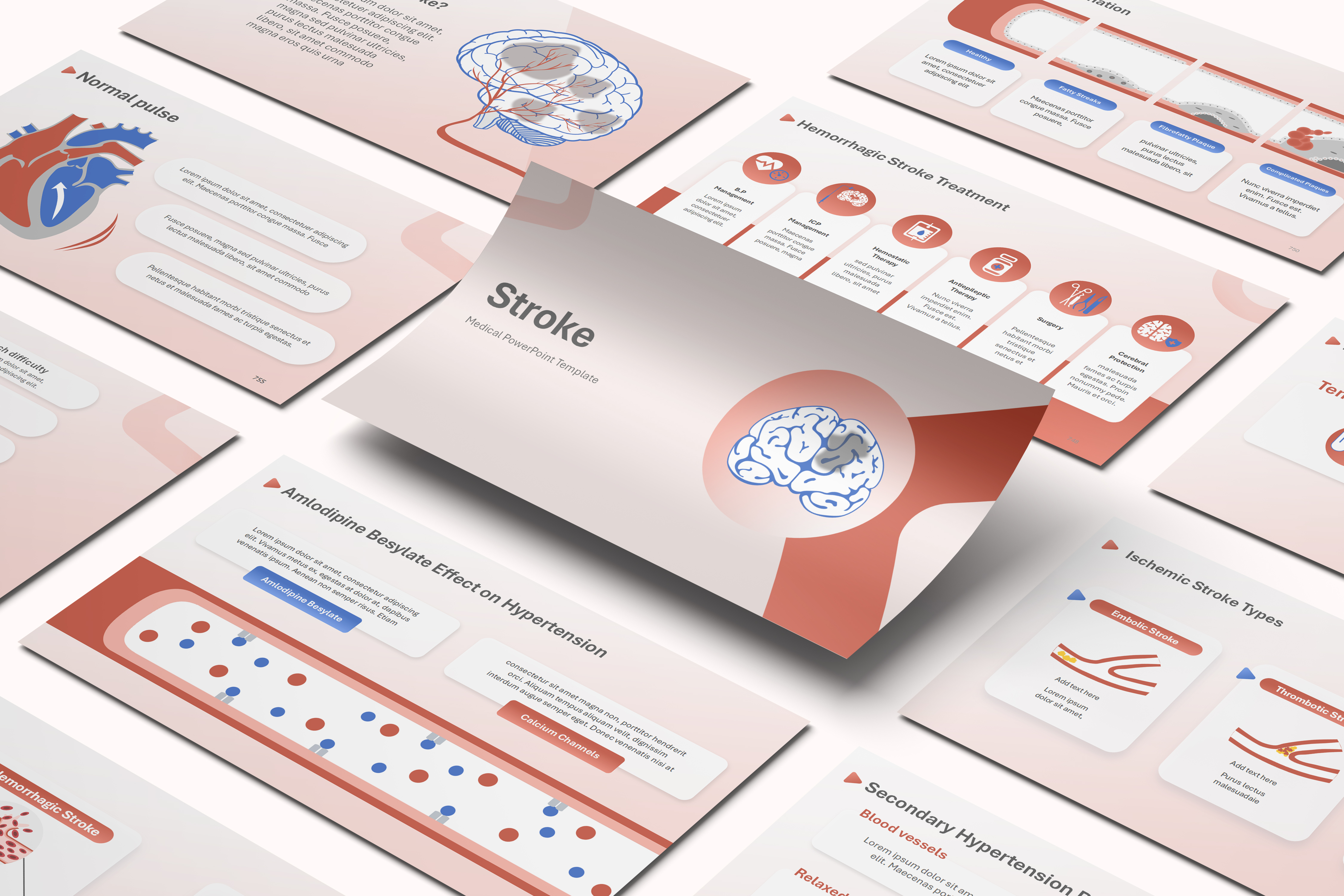




Template Preview
Designed for healthcare professionals creating clear and structured medical presentations.
Ideal for doctors, medical educators, and pharmaceutical teams preparing lectures, clinical education, product presentations, and training.
Fully editable in PowerPoint, allowing you to customize diagrams, charts, and slide layouts with your own medical content
Ready-to-use presentation structure that saves time and helps you build professional healthcare presentations quickly.
Fully Animated
Built-in animations help you present medical information clearly and make complex concepts easier to understand.
Editable Colors and Shapes
Editable colors and shapes help you easily customize the slides to match your content and presentation style, just drag and drop your content.
Professional medical layouts
Professional medical layouts help you organize clinical information, medical data, and treatment insights in a clear and structured way.

Created by Medical Professionals
This template prioritizes medical accuracy, clarity, and real-world usability. Each slide is designed with a medical audience in mind, helping you present clinical information, data, and treatment insights in a way that is structured, credible, and easy for healthcare professionals to understand.
Medical Training for Pharmaceutical & Life Sciences Companies
Neurology and cardiovascular training teams onboarding new sales reps can structure introductory sessions around this 50-slide Stroke template's Circle of Willis anatomy and the ischemic-versus-hemorrhagic-versus-TIA classification, moving from vascular structure through atherosclerotic plaque formation and rupture. New hires get a visual walkthrough of the B.E.F.A.S.T. emergency recognition protocol alongside the acute treatment pathway, IV thrombolysis, mechanical thrombectomy, and antiplatelet therapy, that a field rep will hear referenced in cardiovascular and neurology accounts. The lobe-specific symptom content, covering deficits like Wernicke aphasia and visual agnosia, gives trainees a concrete link between anatomy and clinical presentation. New reps finish training able to explain how a stroke's location and type shape both its symptoms and its urgent treatment window.

Medical Congress & Scientific Conference Presentations
Neurologists and emergency medicine physicians preparing a cerebrovascular session can build around this Stroke template's plaque-rupture and thrombus-formation animations rather than assembling atherosclerosis diagrams independently. The ischemic-versus-hemorrhagic-versus-TIA comparison gives a speaker a ready teaching sequence for a case-based emergency medicine or neurology talk. A Key Opinion Leader presenting at a stroke or neurology conference can pair the existing mechanical-thrombectomy and diagnostic-modality slides with their own institutional outcomes data. The hypertension-and-heart section, linking vascular stress to stroke risk, supports a broader cardiovascular-neurology crossover discussion for a specialist audience.

Pharmaceutical Product & Medical Affairs Presentations
Medical Affairs teams supporting an antihypertensive, antiplatelet, or thrombolytic product can use this Stroke presentation as disease-state groundwork for scientific exchange, covering cerebrovascular anatomy and the atherosclerosis-to-occlusion pathogenesis sequence before any product-specific efficacy data enters the conversation. Medical Science Liaisons can reference the amlodipine besylate mechanism-of-action content when a scientific exchange conversation turns to calcium-channel blockade and blood pressure management in stroke prevention. Because the presentation stays disease-focused rather than promotional, it functions as a starting point that still requires the customer's own medical and compliance sign-off prior to field use. Neurology and cardiovascular teams gain a consistent scientific reference spanning acute stroke management and long-term prevention.

eLearning & SCORM Training Modules
Nursing programs and emergency medicine residencies building a stroke-recognition module can customize this template with their own case scenarios, then convert the finished presentation into a SCORM-compliant module for their learning management system when self-paced study fits the curriculum better. The B.E.F.A.S.T. protocol and diagnostic-modality slides translate naturally into interactive quiz checkpoints within a broader emergency medicine or neurology course. When a program needs a narrower scope, such as acute recognition and triage alone or a version tailored for paramedic versus physician learners, the RxSlides team can adjust the template's coverage and branding. A fully custom presentation designed from scratch remains an option too, for training objectives that don't match anything already in the catalog.
Medical & Healthcare Education
Medical and nursing faculty teaching cerebrovascular disease can use this template's Circle of Willis anatomy to establish normal cerebral blood flow before introducing the ischemic and hemorrhagic disease processes. The lobe-specific symptom breakdown gives students a clear framework for connecting stroke location to clinical presentation, a distinction that's difficult to teach through text alone. The B.E.F.A.S.T. protocol content doubles as a practical teaching tool for emergency recognition training across nursing, EMS, and medical school curricula. Students leave with a structured understanding of the full stroke care continuum, from anatomy and pathogenesis through emergency response and rehabilitation.
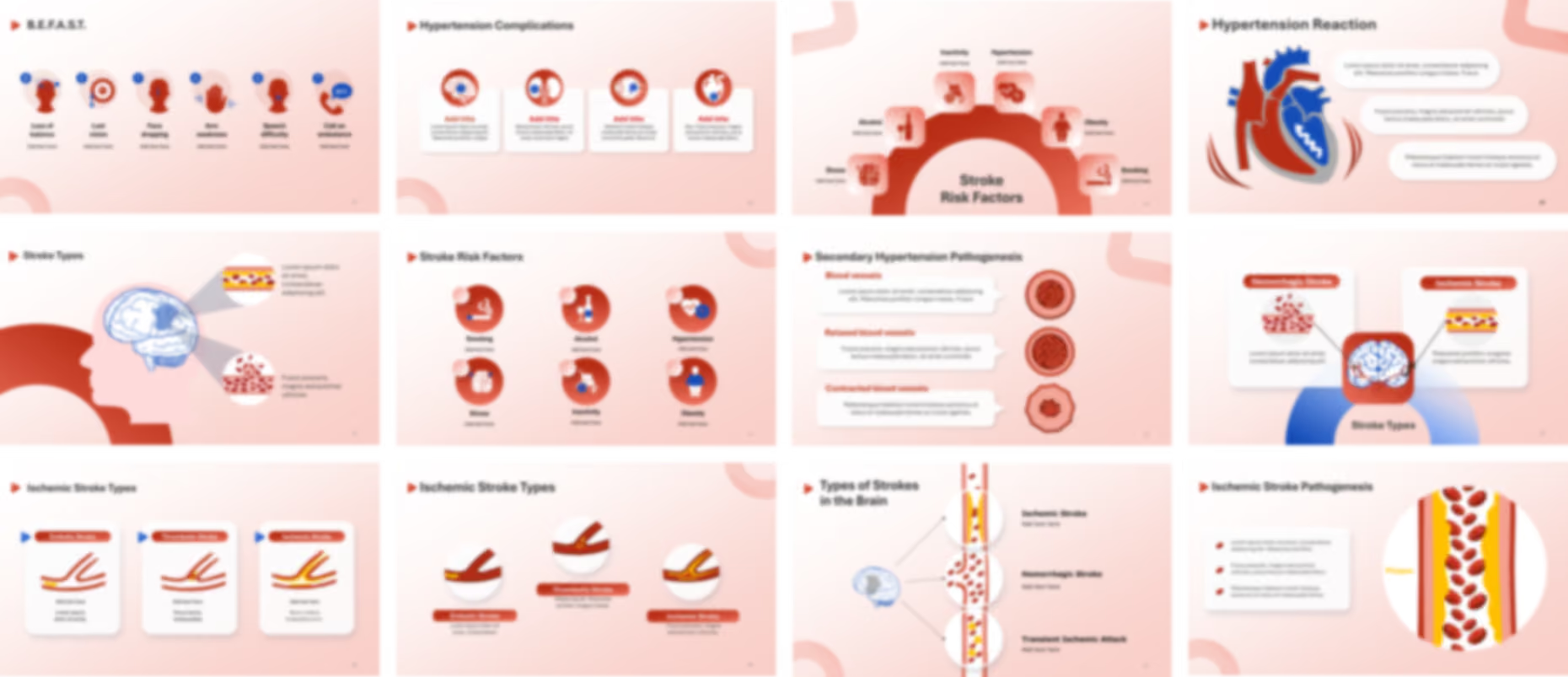
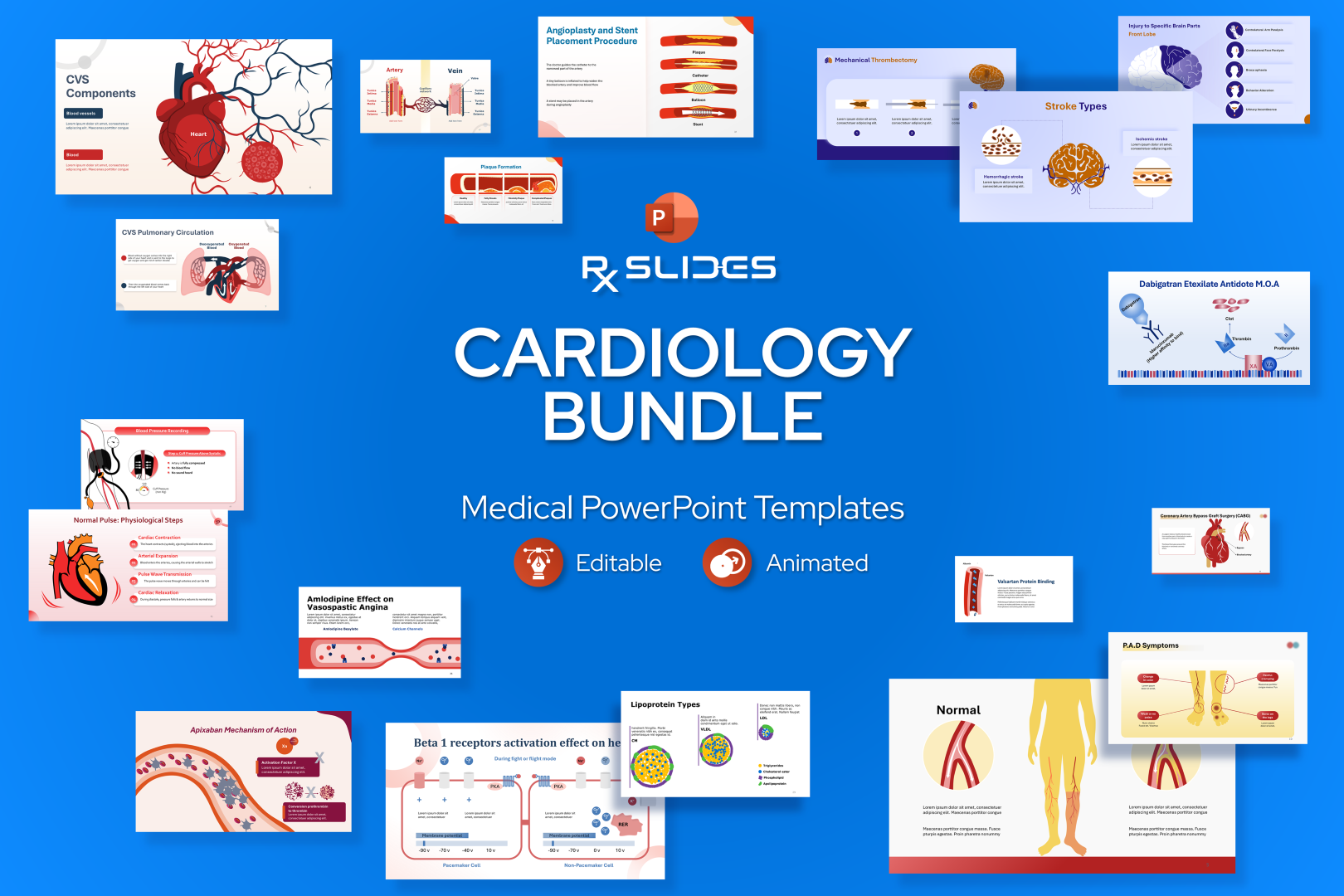
The Stroke PowerPoint template maps the essential arteries of the brain, including the cerebral and basilar arteries, before a definitive comparison slide sets ischemic stroke, hemorrhagic stroke, and transient ischemic attack side by side. Establishing this anatomical foundation first gives educators the structural basis they need before the presentation turns to how each cerebrovascular event actually develops.
A high impact B.E.F.A.S.T. slide teaches rapid recognition of stroke using clear icons for balance, eyes, face, arms, and speech, an essential tool for public health and emergency training. Detailed pathogenesis diagrams then trace the progression of atherosclerosis from plaque buildup and fibrous cap formation through the rupture event and the resulting vessel occlusion or hemorrhage.
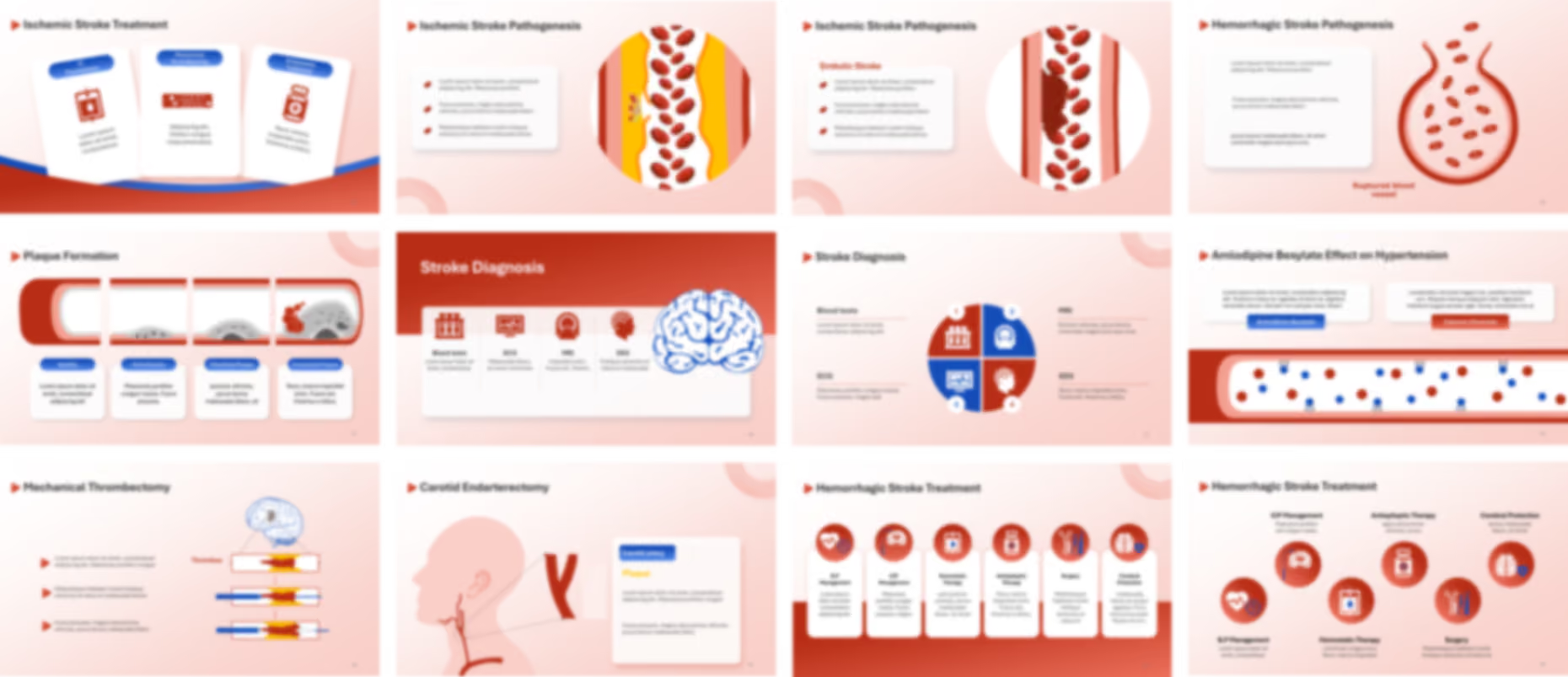
An organized infographic summarizes the four pillars of stroke diagnosis, covering blood tests, MRI imaging, ECG monitoring, and EEG analysis, before treatment slides outline IV thrombolysis, antiplatelet therapy, and mechanical thrombectomy. A step by step surgical visualization shows the stent retriever device capturing and removing a clot, illustrating the procedure in this editable medical diagram set.
Dedicated slides detail the functional impact of injury to the frontal, temporal, parietal, and occipital lobes, covering presentations such as Wernicke aphasia and visual agnosia. The presentation template also links hypertension to vascular stress through detailed heart anatomy diagrams and closes with a lifestyle guide covering blood pressure management, cholesterol control, and diabetes care, rounding out a comprehensive medical presentation template for neurology education.
Ready To Transform Your Presentation ?
Pay once, use forever