Urinary Incontinence PowerPoint Template







Template Preview
Designed for healthcare professionals creating clear and structured medical presentations.
Ideal for doctors, medical educators, and pharmaceutical teams preparing lectures, clinical education, product presentations, and training.
Fully editable in PowerPoint, allowing you to customize diagrams, charts, and slide layouts with your own medical content
Ready-to-use presentation structure that saves time and helps you build professional healthcare presentations quickly.
Fully Animated
Built-in animations help you present medical information clearly and make complex concepts easier to understand.
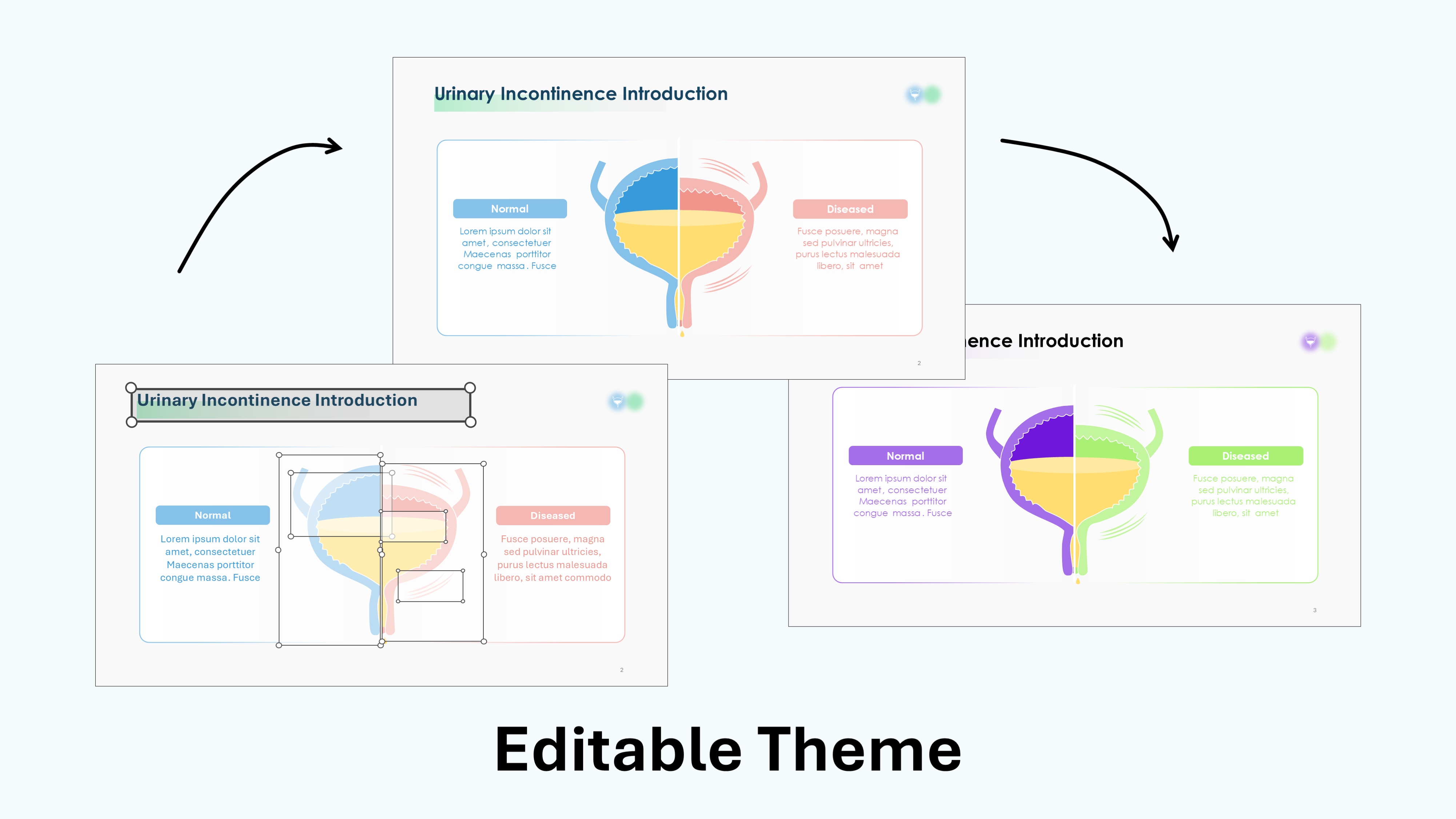
Editable Colors and Shapes
Editable colors and shapes help you easily customize the slides to match your content and presentation style, just drag and drop your content.
Professional medical layouts
Professional medical layouts help you organize clinical information, medical data, and treatment insights in a clear and structured way.

Created by Medical Professionals
This template prioritizes medical accuracy, clarity, and real-world usability. Each slide is designed with a medical audience in mind, helping you present clinical information, data, and treatment insights in a way that is structured, credible, and easy for healthcare professionals to understand.
Medical Training for Pharmaceutical & Life Sciences Companies
Urology and pelvic health training teams onboarding new sales reps can structure introductory sessions around this 40-plus-slide Urinary Incontinence template's continence-mechanism content, tracing neural control from the cerebral cortex and pontine micturition center down through the pelvic and pudendal nerves. New hires get a visual reference for the four primary types, stress, urge, overflow, and total incontinence, alongside the additional functional, overactive, and transient categories. The differential-diagnosis slide, contrasting incontinence against cystitis, overactive bladder, bladder cancer, and bladder stones, gives trainees a structured reference for a workup question they'll hear in the field. New reps finish training able to match a given patient presentation to its correct type and likely cause.

Medical Congress & Scientific Conference Presentations
Urologists and pelvic floor specialists preparing a conference session can turn to this Urinary Incontinence template's five-step pathogenesis sequence rather than assembling bladder-dysfunction diagrams independently. The four-type comparison, stress versus urge versus overflow versus total, gives a speaker a ready framework for a case-based differential-diagnosis discussion. A Key Opinion Leader presenting at a urology or gynecology conference can pair the existing global-prevalence world map with their own regional outcomes data. The six-factor cause breakdown, spanning neurological conditions through enlarged prostate, supports a technically detailed session for a specialist audience.

Pharmaceutical Product & Medical Affairs Presentations
Medical Affairs teams supporting an overactive-bladder or continence-related product can use this Urinary Incontinence presentation as disease-state groundwork for scientific exchange, covering the continence mechanism and four-type classification before any product-specific data enters the conversation. Medical Science Liaisons can present the risk-factor and differential-diagnosis content at advisory boards or KOL discussions to establish shared clinical context around treatment thresholds. Because the presentation stays disease-focused rather than promotional, it hands Medical Affairs groundwork that still has to clear the customer's own medical and compliance review before reaching the field. Urology and gynecology teams gain a consistent visual reference spanning conservative and surgical management options.

eLearning & SCORM Training Modules
Urology residency programs and pelvic floor physical therapy schools building a continence module can customize this Urinary Incontinence template with institution-specific protocols, then convert the finished presentation into a SCORM-compliant module for their learning management system when self-paced study suits the program better. The neural-control and pathogenesis slides translate naturally into interactive checkpoints within a broader urology or women's health course. When a program needs a narrower scope, such as diagnosis and type differentiation alone, or a different depth for PT versus urology learners, the RxSlides team can adjust the template's coverage and branding. Where no existing template matches a specific training objective, the RxSlides team can build a fully custom presentation from scratch.
Medical & Healthcare Education
Medical and physical therapy faculty teaching bladder dysfunction can use this template's male-versus-female anatomy comparison to establish structural differences before introducing the four types of incontinence. The five-step pathogenesis sequence gives students a clear framework for connecting bladder filling and signal processing to the point of uncontrolled leakage. The differential-diagnosis content connects incontinence to related conditions like cystitis and overactive bladder, a distinction students will need on urology and gynecology rotations. Students leave with a structured understanding of how conservative, medical, and surgical treatment options map onto each incontinence type.
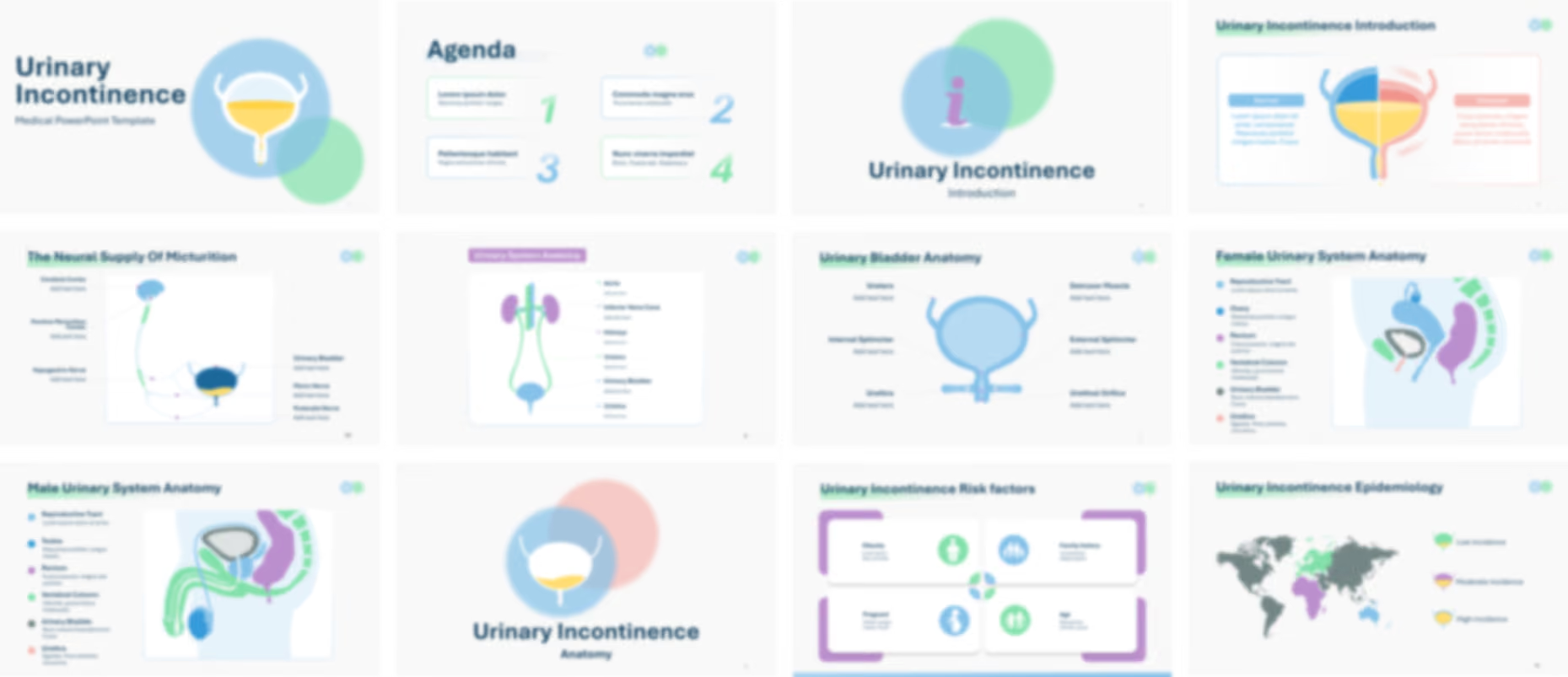
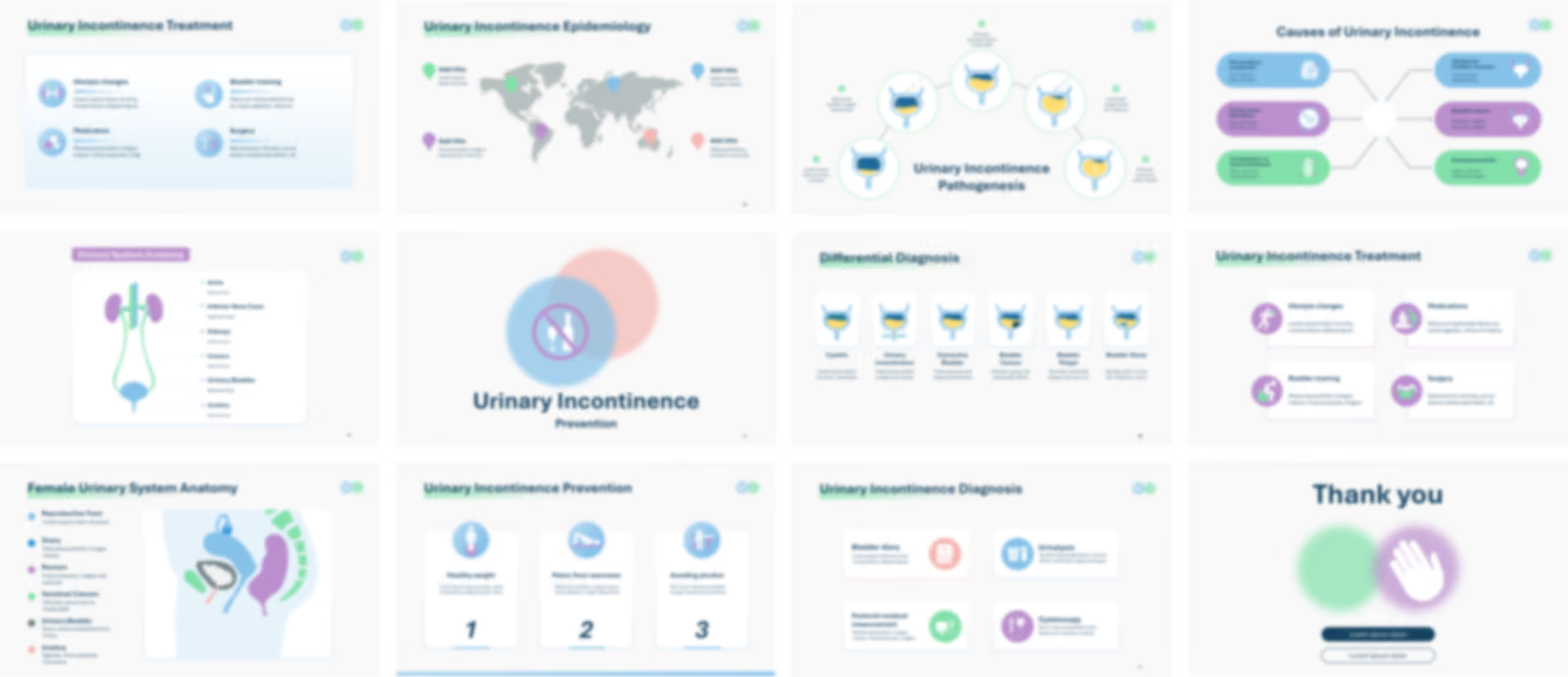
The Urinary Incontinence PowerPoint template opens by contrasting a normal bladder with a diseased, incontinent one before detailed diagrams label the urinary system as a whole and the bladder itself, including the detrusor muscle and internal and external sphincters. Separate cross sections illustrate female and male pelvic anatomy, and a schematic of the neural supply of micturition traces the brain centers and nerves that control urination.
World map visuals and data bars illustrate the global prevalence of urinary incontinence across low, moderate, and high incidence regions, giving presenters an editable framework for regional statistics. Four key risk factors, obesity, family history, pregnancy, and age, are then presented in a clean grid layout, offering a quick reference for clinical discussions in this medical presentation template.
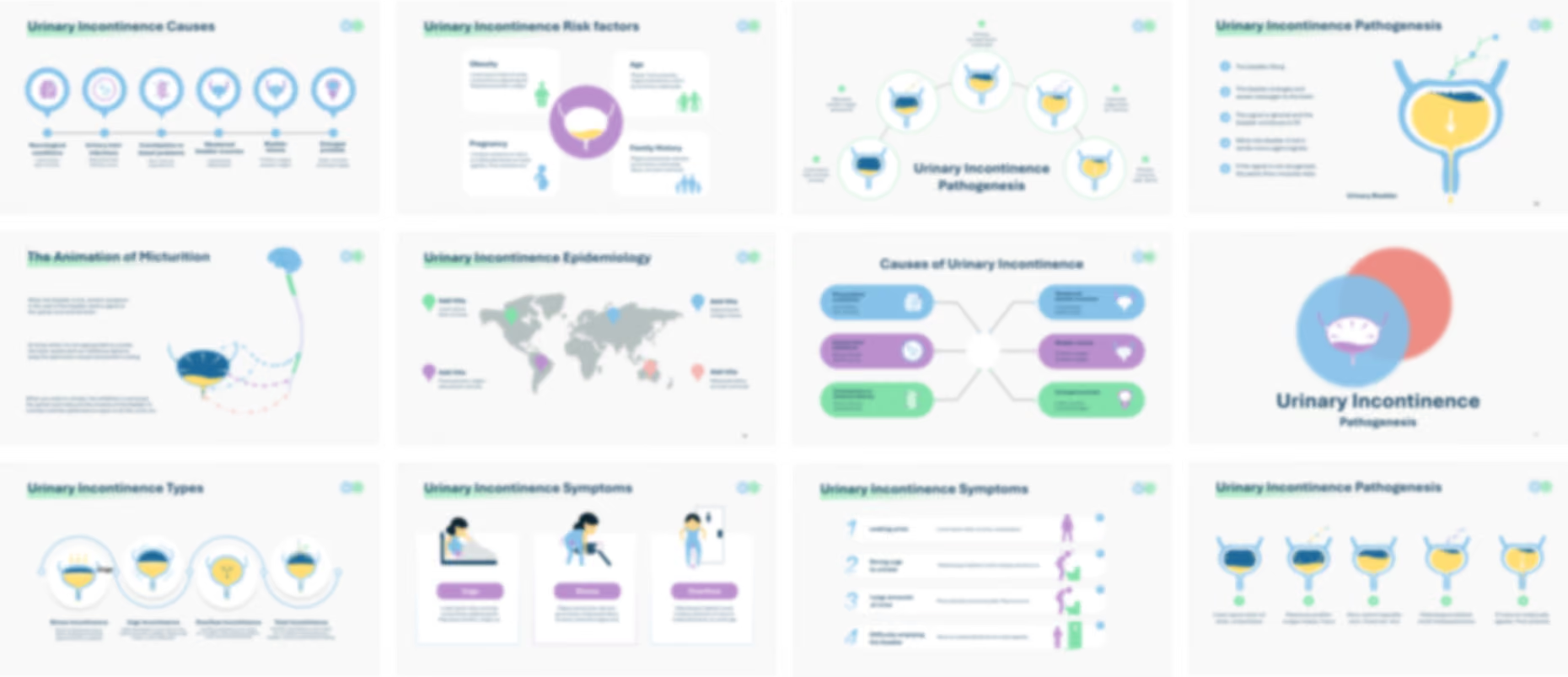
Six etiological factors, ranging from neurological conditions to an enlarged prostate, are illustrated along a horizontal timeline before an animated breakdown of micturition explains the five sequential steps that lead to involuntary leakage. Establishing this pathogenesis first gives educators a shared reference point before the template distinguishes the four main types, stress, urge, overflow, and total incontinence, alongside functional, overactive, and transient forms.
Symptom slides depict the lived experience of urge, stress, overflow, functional, overactive, and transient incontinence, while a four box grid outlines diagnostic procedures including the bladder diary, urinalysis, postvoid residual measurement, and cystoscopy. A differential diagnosis slide compares incontinence against related bladder conditions, and the presentation closes with treatment and prevention slides covering lifestyle changes, medications, bladder training, surgery, and pelvic floor exercises in a set of editable PowerPoint slides.
Ready To Transform Your Presentation ?
Pay once, use forever