Depression PowerPoint Template




Template Preview
Designed for healthcare professionals creating clear and structured medical presentations.
Ideal for doctors, medical educators, and pharmaceutical teams preparing lectures, clinical education, product presentations, and training.
Fully editable in PowerPoint, allowing you to customize diagrams, charts, and slide layouts with your own medical content
Ready-to-use presentation structure that saves time and helps you build professional healthcare presentations quickly.
Fully Animated
Built-in animations help you present medical information clearly and make complex concepts easier to understand.
Editable Colors and Shapes
Editable colors and shapes help you easily customize the slides to match your content and presentation style, just drag and drop your content.
Professional medical layouts
Professional medical layouts help you organize clinical information, medical data, and treatment insights in a clear and structured way.

Created by Medical Professionals
This template prioritizes medical accuracy, clarity, and real-world usability. Each slide is designed with a medical audience in mind, helping you present clinical information, data, and treatment insights in a way that is structured, credible, and easy for healthcare professionals to understand.
Medical Training for Pharmaceutical & Life Sciences Companies
Psychiatry and mental health training teams onboarding new sales reps can structure introductory sessions around this 90-plus-slide Depression template's monoamine deficiency hypothesis, tracing how serotonin, norepinephrine, and dopamine disturbances at the synaptic level connect to distinct symptom clusters. New hires get a visual reference for the four major subtypes, seasonal, postpartum, persistent, and melancholic, alongside the DSM-5 and ICD-10 diagnostic criteria used in clinical practice. The pharmacological-versus-non-pharmacological treatment comparison, covering SSRIs, TCAs, and MAOIs alongside psychotherapy and lifestyle intervention, gives trainees a structured reference for how depression is actually managed. New reps finish training able to connect a specific neurotransmitter deficit to the drug class designed to correct it.
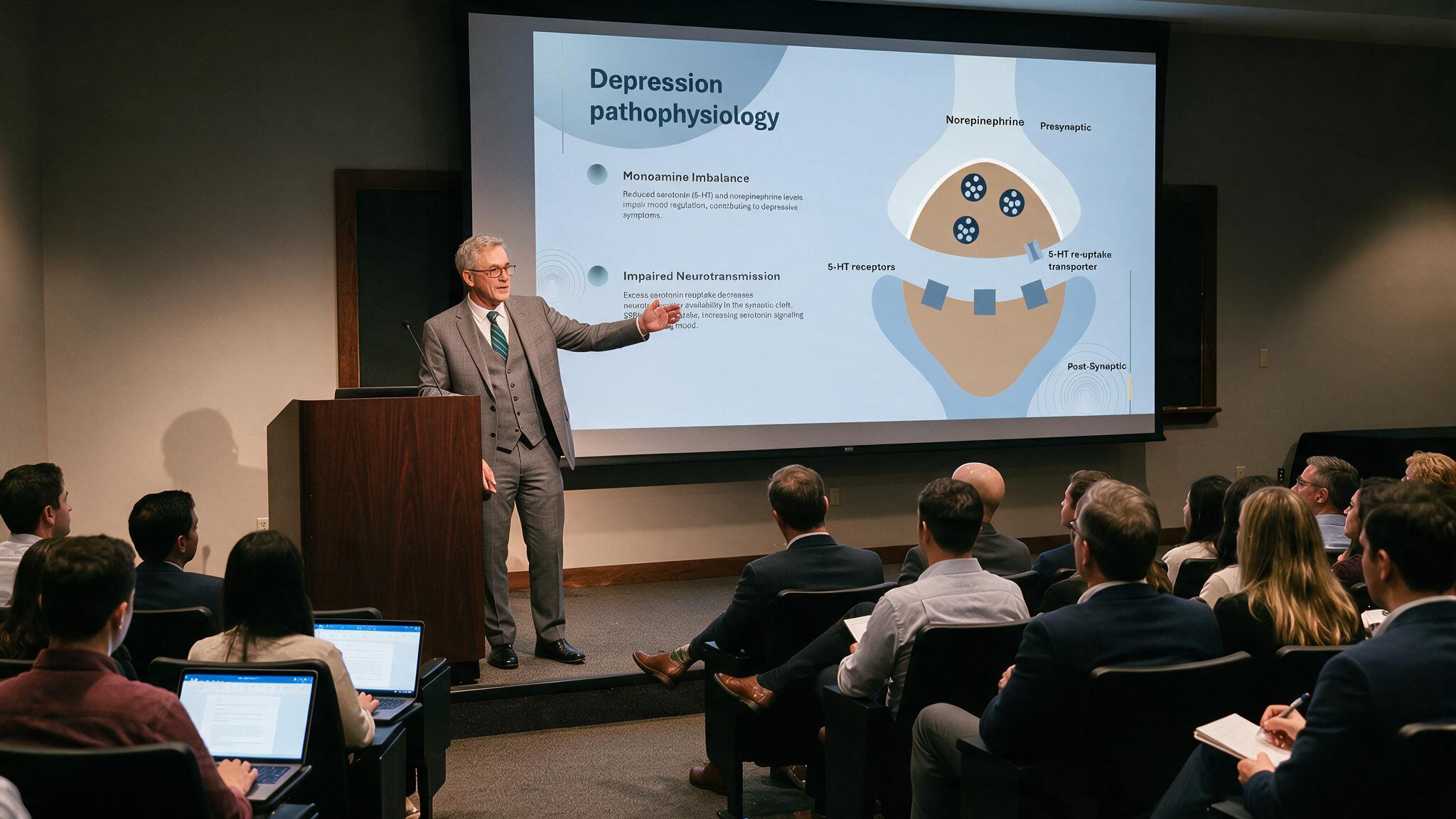
Medical Congress & Scientific Conference Presentations
Psychiatrists and mental health professionals preparing a conference session can build around this Depression template's synaptic transmission animation, showing normal monoamine secretion, receptor interaction, and reuptake before illustrating how that process breaks down in deficiency. The comparative mechanism-of-action sequence for SSRIs, TCAs, and MAOIs gives a speaker a ready framework for a pharmacology-focused discussion distinguishing reuptake inhibition from enzyme inhibition. A Key Opinion Leader presenting at a psychiatry or primary care conference can pair the existing epidemiology and prevalence content with their own regional data. The DSM-5 and ICD-10 diagnostic criteria keep the discussion clinically grounded for a specialist audience.

Pharmaceutical Product & Medical Affairs Presentations
Medical Affairs teams supporting an SSRI, SNRI, or broader antidepressant portfolio can use this Depression presentation as disease-state groundwork for scientific exchange, covering the monoamine deficiency hypothesis and receptor-level pathophysiology before any product-specific data enters the conversation. Medical Science Liaisons can reference the comparative SSRI, TCA, and MAOI mechanism content when a scientific exchange conversation calls for context on why one drug class might be favored over another for a given patient profile. This keeps the deck squarely in disease-education territory --- Medical Affairs gets a scientific-exchange resource, not a promotional one, and it still has to clear the customer's own medical and compliance process before reaching the field. Psychiatry and primary care teams gain a consistent scientific reference spanning diagnosis through pharmacological and non-pharmacological management.

eLearning & SCORM Training Modules
Psychiatry residency programs and psychology departments building a mood-disorders module can customize this Depression template with their own case vignettes, then convert the finished presentation into a SCORM-compliant module for their learning management system when self-paced study fits the curriculum better. The monoamine deficiency and synaptic-transmission animations translate naturally into interactive checkpoints within a broader psychopharmacology or abnormal-psychology course. When a program needs a narrower scope, such as diagnostic criteria alone or a version tailored for nursing versus psychology learners, the RxSlides team can adjust the template's coverage and branding. For a curriculum need that falls outside every existing template, RxSlides can still build a presentation from scratch.
Medical & Healthcare Education
Medical and psychology faculty teaching mood disorders can use this template's monoamine deficiency framework to establish the neurochemical foundation before introducing the clinical subtypes and diagnostic criteria. The SSRI-versus-TCA-versus-MAOI comparison gives students a clear structure for understanding how pharmacological treatment choices map onto the underlying mechanism. The DSM-5 and ICD-10 criteria connect classroom theory to the diagnostic frameworks students will apply in clinical rotations. Students leave with a structured understanding of depression spanning epidemiology, pathophysiology, diagnosis, and the full range of treatment options.
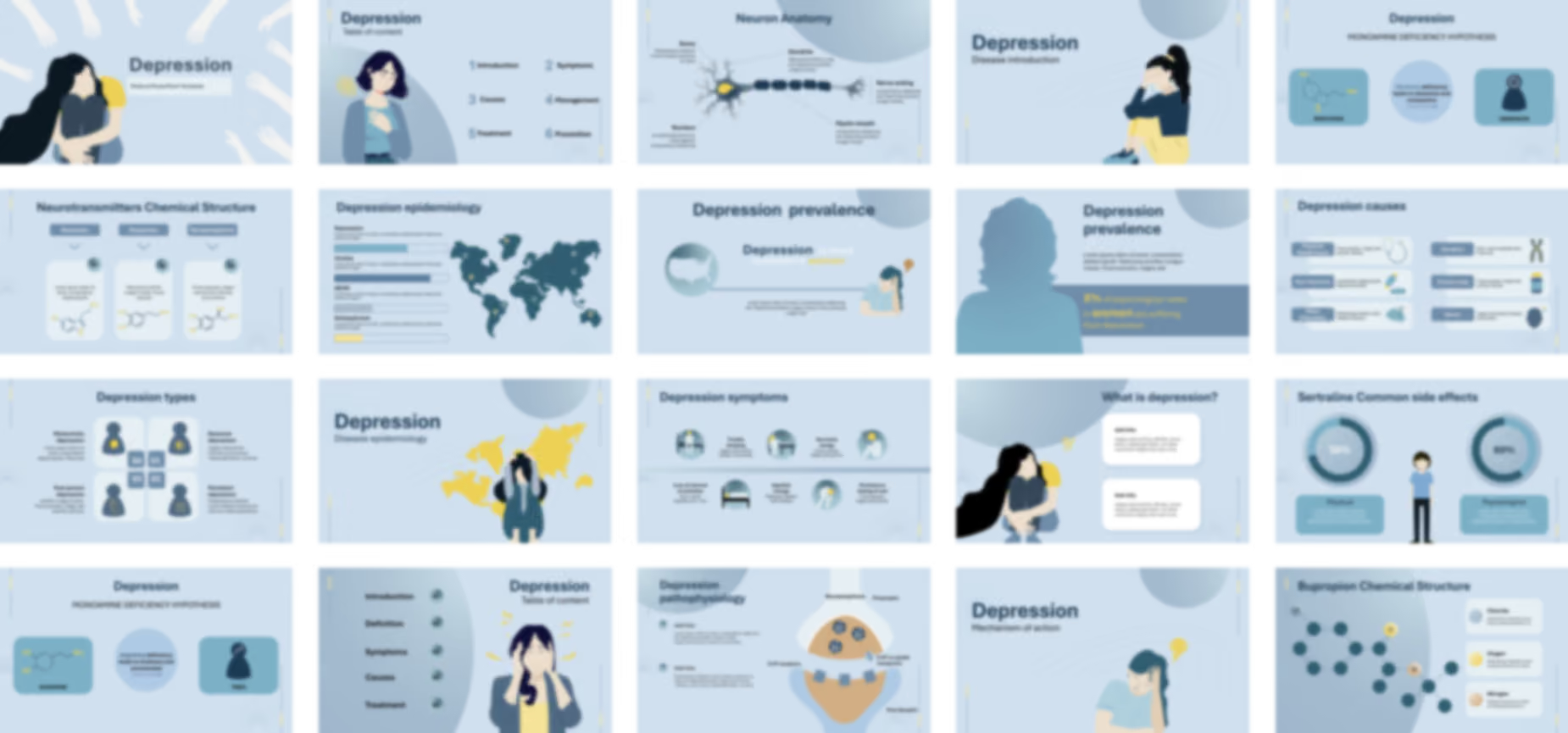
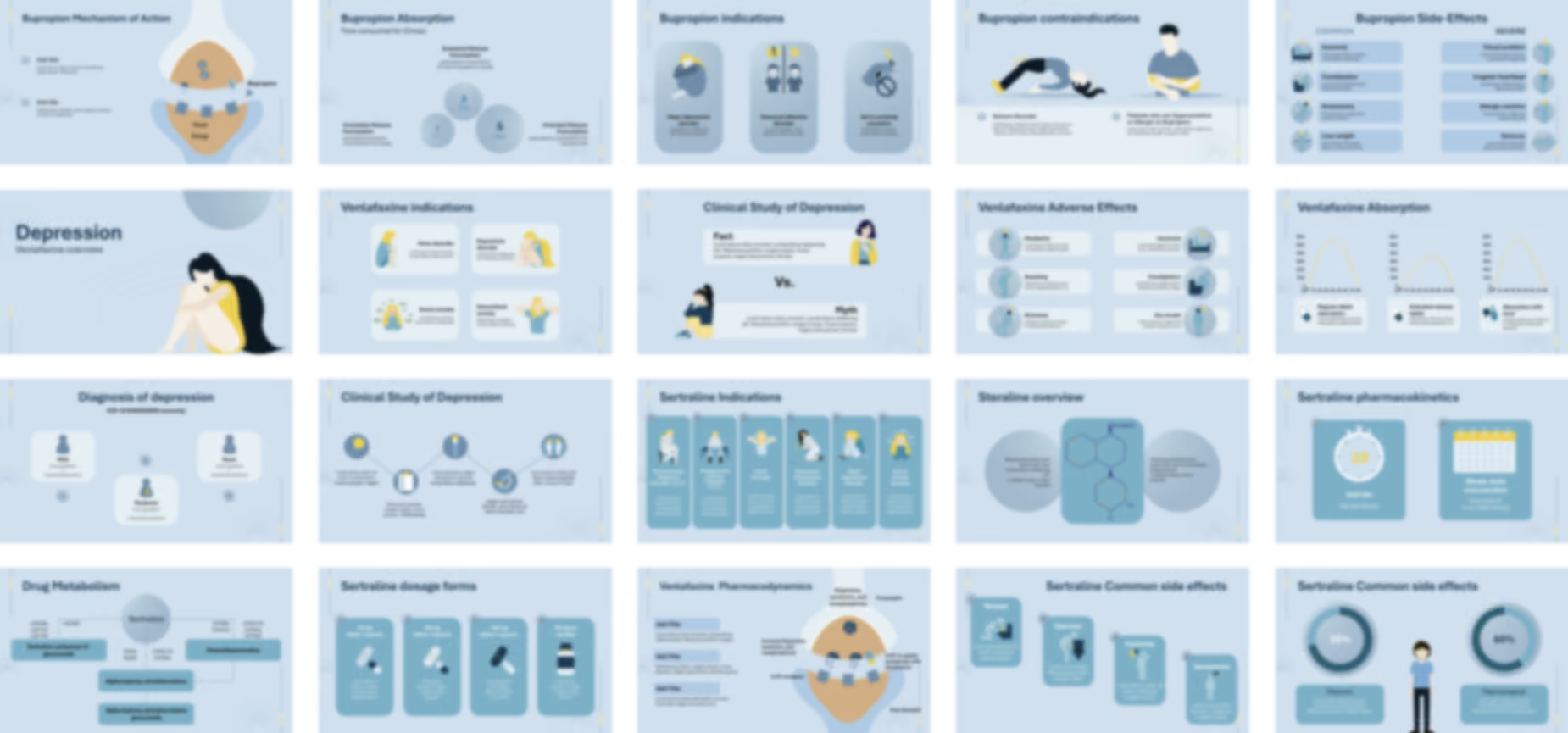
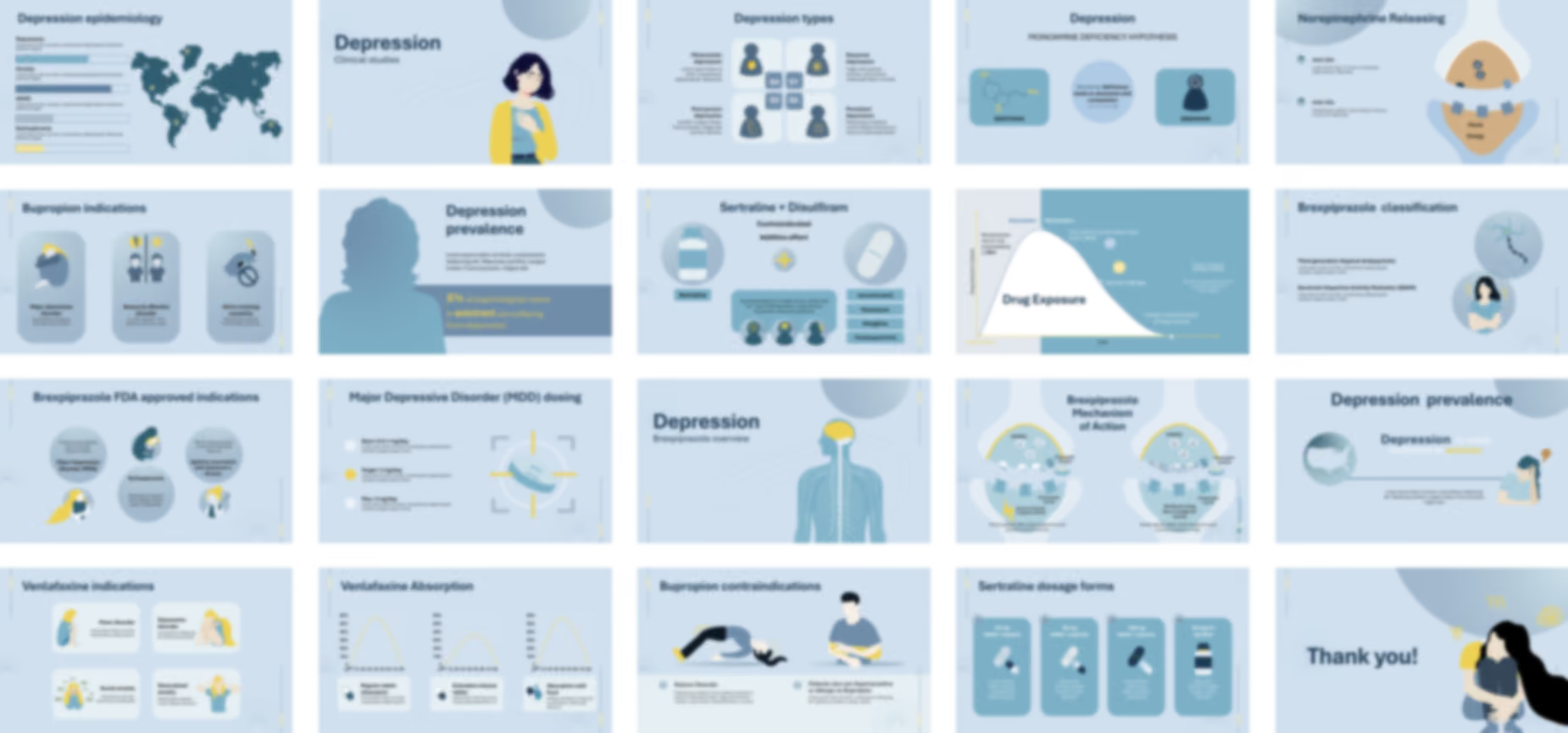
The Depression PowerPoint template opens with cover slides before a definition frames the mood disorder as persistent sadness and loss of interest. Various charts and infographics then visualize epidemiology on global and local levels, showing higher rates among females and increased prevalence in families with an affected relative.
Animated slides with medical icons cover genetic, environmental, and psychological causes before impressive animations illustrate the monoamine deficiency hypothesis, showing how depleted serotonin, norepinephrine, and dopamine drive symptoms such as obsession, anxiety, and low motivation. Establishing this chemical mechanism first gives educators a shared reference point before the sequence animates normal monoamine secretion and reuptake at the nerve ending, followed by transmission depletion and receptor upregulation.
The presentation template presents diagnostic insights based on the DSM-V and ICD-10 criteria before medical illustrations distinguish types of depression, including seasonal, postpartum, persistent, and melancholic, as well as the difference between atypical and clinical presentations, explained through editable medical diagrams.
Dynamic animated illustrations explain the mechanisms of action of SSRIs, TCAs, and MAOIs in maintaining serotonin at the synaptic gap, alongside non-pharmacological options such as psychotherapy, dietary changes, and physical activity. The medical presentation template closes with a quotes slide and a set of icons and illustrations to customize the content further.
Ready To Transform Your Presentation ?
Pay once, use forever