Peripheral Arterial Disease PowerPoint Template

Peripheral Arterial Disease PowerPoint Template
No items found.

Peripheral Artery Disease PowerPoint : Engage with Animated Slides

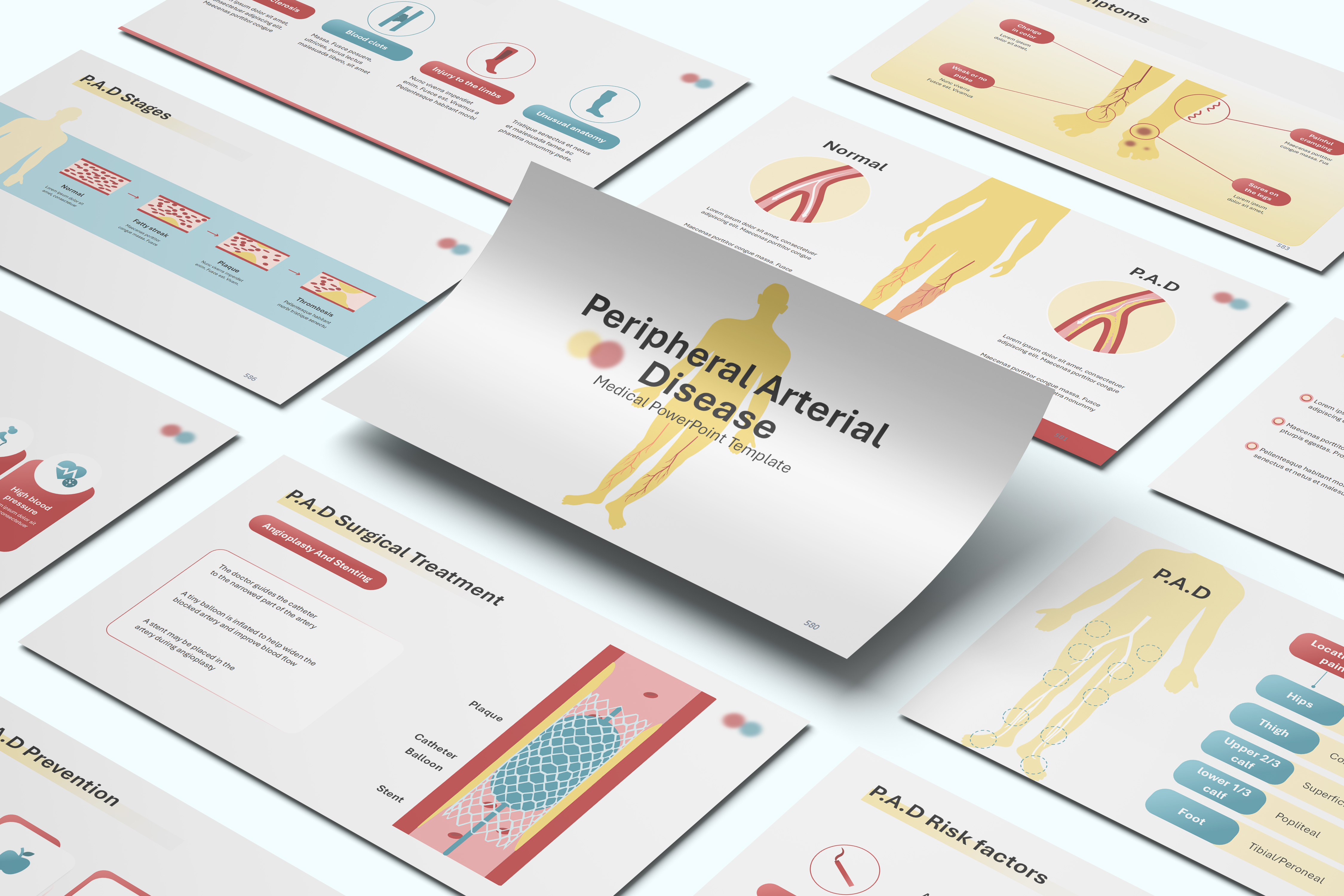
  • The Peripheral Arterial Disease PPT Template is a dynamic medical PowerPoint template designed to enhance the effectiveness of your presentation.
  • Incorporating medical animations and infographics into our slides is expected to attract the intended audience's attention.
  • Our showcased infographics can be utilized to enhance the visual appeal and dynamics of your presentation about Peripheral Arterial Disease, effectively engaging your audience.
  • If you need more illustrations related to heart disease, explore our pre-designed cardiovascular PowerPoint templates to get a variety of animations and layouts to choose from, allowing you to focus on developing your message and making a lasting impression.

Peripheral Artery Disease PowerPoint Template Content

Slide 1 - Title Slide: Peripheral Arterial Disease

Title Slide: Peripheral Arterial Disease
  • Title slide to introduce the presentation on Peripheral Arterial Disease (PAD).
  • The slide features a large, central illustration of a human silhouette in yellow with a highlighted network of red arteries in the legs, visually emphasizing the affected area of the body.
  • The title is displayed in bold, clear black font, and the text "Medical PowerPoint Template" is present below.

Slide 2 - Agenda (Red/Yellow Style)

Agenda (Red/Yellow Style)
  • Agenda slide to provide a clear overview of the four main sections of the Peripheral Arterial Disease presentation.
  • The design uses a clean, four-box layout with prominent numbering (1-4) in bold red and yellow-orange gradient colors.

Slide 3 - Peripheral Arterial Disease: Introduction (Section Title)

Peripheral Arterial Disease: Introduction (Section Title)
  • Section divider slide to transmit to the introductory definitions of Peripheral Arterial Disease (PAD).
  • The slide features a large, central "i" icon overlaid on blurred yellow and blue-green circles, setting an informative tone.

Slide 4 - P.A.D Introduction (Normal vs. Narrowed Artery)

P.A.D Introduction (Normal vs. Narrowed Artery)
  • Introduces Peripheral Arterial Disease (PAD) by contrasting a healthy artery with a diseased one.
  • The design features an illustration of the lower leg arteries alongside two magnified cross-sections: "Normal Artery" (clear, open) and "Narrowed Artery" (showing plaque buildup, consistent with atherosclerosis).

Slide 5 - P.A.D Comparison (Full Body and Magnified Arteries)

P.A.D Comparison (Full Body and Magnified Arteries)
  • Compares the anatomy of a Normal leg artery versus an artery affected by P.A.D.
  • The slide features a large, central human silhouette, with the right leg showing the healthy red arterial network and the left leg shaded orange to indicate the diseased limb.
  • Two magnified circular insets, labeled Normal (clear blood flow) and P.A.D (plaque obstruction), provide close-up views of the arterial pathology, supported by two bullet points of text under each section.

Slide 6 - Peripheral Arterial Disease: Epidemiology (Section Title)

Peripheral Arterial Disease: Epidemiology (Section Title)
  • Section divider slide to transmit to the statistical and population data on Peripheral Arterial Disease (PAD).
  • The slide features a central group of three human silhouettes (one white, one red, one yellow) overlaid on blurred yellow and blue-green circles.

Slide 7 - P.A.D Prevalence (Global Statistics)

P.A.D Prevalence (Global Statistics)
  • Presents the estimated Prevalence of Peripheral Arterial Disease (P.A.D.) across different global regions.
  • The design uses three large circular callouts, each featuring a red silhouette map for a major region (Asia/Australia, Europe/North America, and Africa) with placeholders for the corresponding percentage data (XX%).

Slide 8 - P.A.D Prevalence (Gender and Regional Comparison)

P.A.D Prevalence (Gender and Regional Comparison)
  • Presents the Prevalence of Peripheral Arterial Disease (P.A.D.) broken down by gender and select regions.
  • The design features two main visual components:
    • Gender Icons: Large graphics representing groups of Women (pink icons) and Men (blue icons).
    • Regional Data: Two circular bar charts display placeholders (XX%) for the prevalence of P.A.D in Women in Asia/Australia (red chart) and Men in Africa (blue chart).

Slide 9 - Peripheral Arterial Disease: Symptoms (Section Title)

Peripheral Arterial Disease: Symptoms (Section Title)

Slide 10 - P.A.D Symptoms (Visual Locator)

P.A.D Symptoms (Visual Locator)
  • Locates and describes 4 symptoms of Peripheral Arterial Disease (P.A.D.) in the lower limbs.
  • The design features a central illustration of the legs and feet, using lines to connect the anatomical area to descriptive text boxes for symptoms like "Change in color," "Painful cramping," "Weak or no pulse," and "Sores on the legs".

Slide 11 - Peripheral Arterial Disease: Causes (Section Title)

Peripheral Arterial Disease: Causes (Section Title)
  • Section divider slide to transmit to Causes of Peripheral Arterial Disease (P.A.D.).
  • The slide features a central icon of a magnified cross-section of a diseased artery (showing plaque buildup in red and yellow) overlaid on blurred yellow and blue-green circles.

Slide 12 - P.A.D Causes

P.A.D Causes
  • Outlines the four primary Causes of Peripheral Arterial Disease (P.A.D.).
  • The design uses a four column layout, with each column detailing a specific cause: Atherosclerosis, Blood clots, Injury to the limbs, and Unusual anatomy.
  • Each cause is represented by a large icon and a colored title bar (red for tissue/artery issues, blue for clots/anatomy).

Slide 13 - P.A.D Causes (Icon-Focused Layout)

P.A.D Causes (Icon-Focused Layout)
  • Outlines the four primary Causes of Peripheral Arterial Disease (P.A.D.) using large, central icons.
  • The design features four circular icons representing: Atherosclerosis (cross-section showing blockage), Blood clots (cross-section showing clot), Injury to the limbs (foot/leg), and Unusual anatomy (full leg).
  • Red lines connect these central icons to the descriptive text on the periphery.

Slide 14 - Peripheral Arterial Disease: Pathophysiology (Section Title)

Peripheral Arterial Disease: Pathophysiology (Section Title)
  • Section divider slide to transmit to the Pathophysiology of Peripheral Arterial Disease (P.A.D.).
  • The slide features a central icon of a magnifying glass (red border, yellow handle) overlaid on blurred yellow and blue-green circles.

Slide 15 - P.A.D Pathophysiology (Atherosclerosis Mechanism)

P.A.D Pathophysiology (Atherosclerosis Mechanism)
  • Explains the main Pathophysiology of Peripheral Arterial Disease (P.A.D.), which is Atherosclerosis.
  • The design features a central illustration of the lower leg arteries with a magnified cross section showing a thick, yellow Plaque buildup on the artery wall.
  • The text states that a major cause of PAD is the building up of plaques in arteries, known as atherosclerosis.

Slide 16 - P.A.D Pathophysiology (Embolus Mechanism)

P.A.D Pathophysiology (Embolus Mechanism)
  • Explains the main Pathophysiology of Peripheral Arterial Disease (P.A.D.) specifically related to an Embolus.
  • The design features a central illustration of the lower leg arteries with a magnified cross-section showing an artery obstructed by an Embolus (a yellow object).
  • The text explicitly states that a major cause of PAD is the building up of plaques in arteries, known as atherosclerosis, which can break off and form an embolus.

Slide 17 - Peripheral Arterial Disease: Stages (Section Title)

Peripheral Arterial Disease: Stages (Section Title)
  • Section divider slide to transmit to the topic of the Stages.
  • The slide features a central icon of a stepped bar chart with an upward-pointing red arrow overlaid on blurred yellow and blue-green circles.

Slide 18 - P.A.D Stages (Five-Step Progression)

P.A.D Stages (Five-Step Progression)
  • Presents the five stages of disease progression.
  • The design features five distinct, numbered vertical boxes (01 to 05), each illustrating a step in the pathology:
    • 01 Normal artery (clear flow).
    • 02 Endothelial dysfunction.
    • 03 Fatty streak formation.
    • 04 Stable plaque formation (showing definite plaque buildup).
    • 05 Plaque rupture thrombosis (showing advanced, complicated lesion).

Slide 19 - P.A.D Stages (Plaque Rupture Detail)

P.A.D Stages (Plaque Rupture Detail)
  • Emphasizes the most critical stage of the disease: Plaque rupture with thrombosis.
  • The design features a large cross-section of an artery showing complex pathology, including plaque rupture, platelet aggregation (thrombosis), and exposed subendothelial material.

Slide 20 - P.A.D Stages (Normal Artery Detail)

P.A.D Stages (Normal Artery Detail)
  • Anatomical baseline of a Normal artery.
  • The design features a large, detailed cross-section of a healthy artery showing clear, unobstructed blood flow (indicated by small red particles and white arrows).

Slide 21 - P.A.D Stages (Endothelial Dysfunction Detail)

P.A.D Stages (Endothelial Dysfunction Detail)
  • Emphasizes the earliest stage of the disease: Endothelial dysfunction.
  • The design features a large, detailed cross-section of an artery showing potential damage to the inner lining of the blood vessel.
  • Clear, unobstructed blood flow contrasting the subsequent stages where plaque builds up.

Slide 22 - P.A.D Stages (Fatty Streak Formation Detail)

P.A.D Stages (Fatty Streak Formation Detail)
  • Emphasizes the stage of Fatty streak formation in the progression of Peripheral Arterial Disease (P.A.D.).
  • Represents the earliest physical sign of plaque buildup: small clusters of yellow fat/lipids starting to adhere to the vessel wall.

Slide 23 - P.A.D Stages (Stable Plaque Formation Detail)

P.A.D Stages (Stable Plaque Formation Detail)
  • Emphasizes the stage of Stable plaque formation in the progression of Peripheral Arterial Disease (P.A.D.).
  • The design features a large, detailed cross-section of an artery that visually represents a mature, calcified plaque that is firmly attached to the vessel wall.
  • The yellow-red color scheme clearly highlights the pathology against the artery wall.

Slide 24 - P.A.D Stages (Plaque Rupture with Thrombosis Detail - Variation)

P.A.D Stages (Plaque Rupture with Thrombosis Detail - Variation)
  • Emphasizes Plaque rupture with thrombosis.
  • The design features a large, detailed cross-section of an artery shows plaque rupture and the formation of a thrombus (blood clot).

Slide 25 - P.A.D Stages (Linear Progression Overview)

P.A.D Stages (Linear Progression Overview)
  • Provides a clear, linear overview of the four main stages in the progression of Peripheral Arterial Disease (P.A.D.).
  • The slide features a central horizontal flow chart with four magnified artery cross-sections.
  • The left side of the slide features a human silhouette with highlighted leg arteries.

Slide 26 - P.A.D Pain Location and Involved Artery

P.A.D Pain Location and Involved Artery
  • Defines the correlation between the anatomical site of pain and the specific large artery affected in Peripheral Arterial Disease (P.A.D.).
  • The design features a human silhouette on the left with five distinct pain areas in the legs circled in blue dashed lines.
  • A corresponding table on the right maps the Location of pain (Hips, Thigh, Upper 2/3 calf, lower 1/3 calf, Foot) to the Involved Artery (Lower aorta/iliac, Common femoral, Superficial femoral, Popliteal, Tibial/Peroneal).

Slide 27 - Peripheral Arterial Disease: Risk Factors (Section Title)

Peripheral Arterial Disease: Risk Factors (Section Title)
  • Section divider slide to transmit to the Risk Factors for Peripheral Arterial Disease (P.A.D.).
  • The slide features a large, central red warning triangle icon overlaid on blurred yellow and blue-green circles, visually emphasizing the seriousness of these contributing factors.

Slide 28 - P.A.D Risk Factors (Six Key Factors)

P.A.D Risk Factors (Six Key Factors)
  • Outlines six primary risk factors for Peripheral Arterial Disease (P.A.D.).
  • The design uses six distinct, red-colored column blocks, each containing a dedicated icon and descriptive text: Smoking (cigarette icon), Diabetes (test strip icon), High cholesterol (blood drop icon), Atherosclerosis (artery icon), Age above 60 years (elderly person icon), and High blood pressure (heart monitor icon).

Slide 29 - P.A.D Risk Factors (Timeline/Flow Layout)

P.A.D Risk Factors (Timeline/Flow Layout)
  • Presents six primary risk factors for Peripheral Arterial Disease (P.A.D.) in a progression format.
  • The design uses a central horizontal red and blue gradient bar with downward and upward pointing markers.
  • The risk factors shown include Smoking, Atherosclerosis, High cholesterol, High blood pressure, Diabetes, and Age above 60 years, each associated with a corresponding medical icon.

Slide 30 - Peripheral Arterial Disease: Diagnosis (Section Title)

Peripheral Arterial Disease: Diagnosis (Section Title)
  • Section divider slide to transmit Diagnosis for Peripheral Arterial Disease (P.A.D.).
  • The slide features a central icon of a red medical monitor with a pulse reading (ECG or vascular wave) overlaid on blurred yellow and blue-green circles.

Slide 31 - Diagnosis of P.A.D (Blood Sample Analysis)

Diagnosis of P.A.D (Blood Sample Analysis)
  • Represents one aspect of the diagnostic process for Peripheral Arterial Disease (P.A.D.).
  • The design features four prominent test tubes filled with red (blood cells) and yellow (plasma/serum) liquid in the center.
  • Four text bubbles surround the test tubes, providing space for titles (e.g., Lipid Profile, HbA1c, CRP) and descriptions of the blood tests or related findings.

Slide 32 - P.A.D Diagnosis (Six Key Methods)

P.A.D Diagnosis (Six Key Methods)
  • Outlines the six primary diagnostic methods for Peripheral Arterial Disease (P.A.D.).
  • The design uses six distinct, red-colored circular icons, each representing a step in the diagnostic process:
    • Medical history (checklist icon).
    • Blood test (test tube icon).
    • Doppler ultrasound (monitor/ECG icon).
    • Ankle-brachial index (ABI) (blood pressure cuff icon).
    • Angiogram (MRI/scanner icon).
    • Physical examination (person being examined icon).

Slide 33 - P.A.D Diagnosis (Three Key Methods Focus)

P.A.D Diagnosis (Three Key Methods Focus)
  • This slide shows three of the most crucial diagnostic methods for Peripheral Arterial Disease (P.A.D.).
  • The design uses three distinct red-bordered column blocks, each detailing one of the methods: Medical history, Doppler ultrasound, and Angiogram.
  • Each method is accompanied by a large blue circular icon (checklist, monitor, and scanner icons).

Slide 34 - P.A.D Diagnosis (ABI, Blood Test, and Physical Exam Focus)

P.A.D Diagnosis (ABI, Blood Test, and Physical Exam Focus)
  • This slide shows essential diagnostic methods for Peripheral Arterial Disease (P.A.D.), particularly the Ankle-brachial index (ABI).
  • The design uses three distinct red-bordered column blocks, each detailing one of the methods: Ankle-brachial index (ABI), Blood test, and Physical examination.
  • Each method is accompanied by a large blue circular icon (blood pressure cuff, test tube, and examination icons).

Slide 35 - Peripheral Arterial Disease: Treatment (Section Title)

Peripheral Arterial Disease: Treatment (Section Title)
  • Section divider slide transmit to Treatment for Peripheral Arterial Disease (P.A.D.).
  • The slide features a central icon of a red and white pill/capsule and a small tablet overlaid on blurred yellow and blue-green circles.

Slide 36 - P.A.D Treatment (Four Main Approaches)

P.A.D Treatment (Four Main Approaches)
  • Outlines the four main treatment approaches for Peripheral Arterial Disease (P.A.D.).
  • The design uses a four column layout, with each column detailing a specific category:
    • Healthy lifestyle (Apple and banana icon).
    • Exercises (Barbell icon).
    • Surgery (Scissors and scalpel icon).
    • Medicines (Pills/capsule icon).
  • Each approach is presented with a red circular icon and provides space for descriptive text.

Slide 37 - P.A.D Treatment (Four Main Approaches)

P.A.D Treatment (Four Main Approaches)
  • Alternative slide of Slide 36.

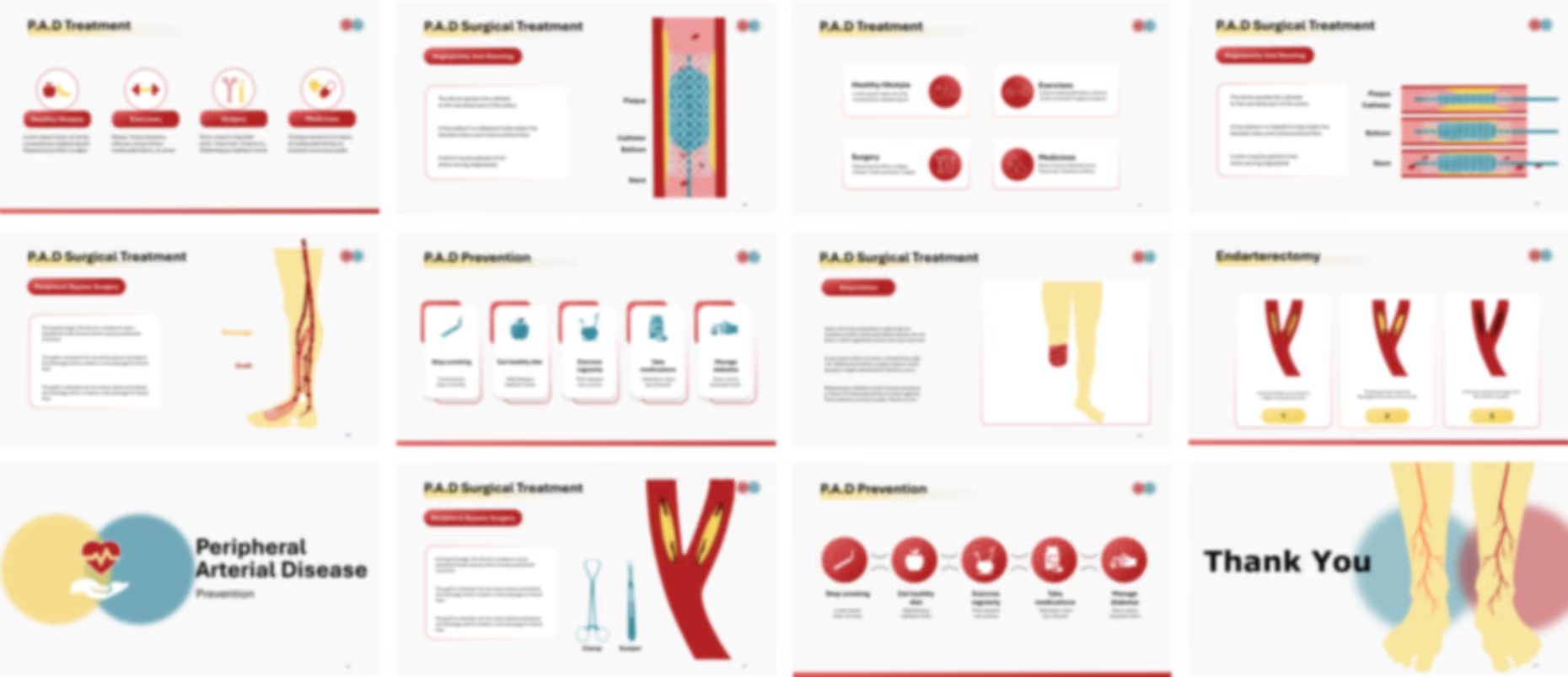
Slide 38 - P.A.D Surgical Treatment (Angioplasty and Stenting)

P.A.D Surgical Treatment (Angioplasty and Stenting)
  • Explains the common interventional procedure of Angioplasty and Stenting for treating blocked arteries in Peripheral Arterial Disease (P.A.D.).
  • The design features a large, magnified illustration on the right side demonstrating the steps of the procedure inside a blood vessel.
  • Key components of the procedure are labelled on the illustration, including the Plaque, Catheter, Balloon, and Stent.
  • Corresponding bullet points on the left describe the steps: guiding the catheter, inflating the balloon to widen the artery, and placing a stent.

Slide 39 - P.A.D Surgical Treatment (Angioplasty and Stenting - Detailed View)

P.A.D Surgical Treatment (Angioplasty and Stenting - Detailed View)
  • Explains the procedure of Angioplasty and Stenting.
  • The design features a large, magnified, three-step sequential illustration on the right demonstrating the stages of the procedure inside a blood vessel.
    • Top image: Catheter insertion at the plaque site.
    • Middle image: Balloon inflation to compress the plaque.
    • Bottom image: Stent deployment to maintain vessel patency.
  • Key components are labelled on the right: Plaque, Catheter, Balloon, and Stent.

Slide 40 - P.A.D Surgical Treatment (Peripheral Bypass Surgery)

P.A.D Surgical Treatment (Peripheral Bypass Surgery)
  • Explains the reconstructive surgical procedure of Peripheral Bypass Surgery for restoring blood flow around a blockage in Peripheral Arterial Disease (P.A.D.).
  • The design features a large, detailed illustration of the lower leg arteries on the right side. The image clearly shows a Blockage and a Graft stitched to the artery to create a new pathway for blood.
  • The text on the left explains the rationale: a blockage causes peripheral ischemia (lack of blood to tissues) and the graft is stitched above and below the blockage to create a new passage for blood flow.

Slide 41 - P.A.D Surgical Treatment (Surgical Tools Detail)

P.A.D Surgical Treatment (Surgical Tools Detail)
  • Illustrates the tools used during Peripheral Bypass Surgery or other surgical interventions for Peripheral Arterial Disease (P.A.D.).
  • The design features illustrations of a Clamp and a Scalpel in the center.
  • A large, magnified illustration on the right shows a y-shaped arterial bifurcation with two blockages (yellow plaque).
  • The text on the left reiterates the key surgical concept of treating peripheral ischemia caused by blockage and creating a new blood flow passage with a graft.

Slide 42 - Endarterectomy

Endarterectomy
  • Outlines three primary preventative measures for Endarterectomy.
  • The slide features three numbered blocks, each detailing a key intervention: Healthy weight, Pelvic floor exercises, and Avoiding alcohol.
  • Each intervention is accompanied by a light blue circular icon and numbered prominently at the bottom (1, 2, 3).

Slide 43 - P.A.D Surgical Treatment (Amputation)

P.A.D Surgical Treatment (Amputation)
  • The design features a prominent illustration of a lower leg amputation on the right side.
  • The text explains that lower extremity amputation is generally reserved for situations where revascularization options do not exist or when significant tissue loss has occurred.

Slide 44 - Peripheral Arterial Disease: Prevention (Section Title)

Peripheral Arterial Disease: Prevention (Section Title)
  • Section divider slide to transmit to Prevention for Peripheral Arterial Disease (P.A.D.).
  • The slide features a central icon of a white hand holding a red heart with a white ECG/pulse line.
  • The icon is overlaid on blurred yellow and blue circles.

Slide 45 - P.A.D Prevention (Five Key Pillars)

P.A.D Prevention (Five Key Pillars)
  • Summarizes five key preventative measures for Peripheral Arterial Disease (P.A.D.).
  • The design uses five distinct, pill-shaped blocks, each detailing a preventative measure with a corresponding icon:
    • Stop smoking (Cigarette icon).
    • Eat healthy diet (Apple icon).
    • Exercise regularly (Stationary bike icon).
    • Take medications (Pill bottle icon).
    • Manage diabetes (Blood glucose meter icon).

Slide 46 - P.A.D Prevention (Flow Chart)

P.A.D Prevention (Flow Chart)
  • Flow-chart slide to summarize five key preventative measures for Peripheral Arterial Disease (P.A.D.).
  • The design uses a sequence of five red circular icons connected by arrows/lines, illustrating the continuous nature of prevention:
    • Stop smoking (Cigarette icon).
    • Eat healthy diet (Apple icon).
    • Exercise regularly (Stationary bike icon).
    • Take medications (Pill bottle icon).
    • Manage diabetes (Blood glucose meter icon).

Slide 47 - Thank You (P.A.D. Conclusion)

Thank You (P.A.D. Conclusion)
  • Concludes the presentation on Peripheral Arterial Disease (P.A.D.).
  • A subtle illustration of the lower legs with visible arteries is positioned on the right.

Features of the Template

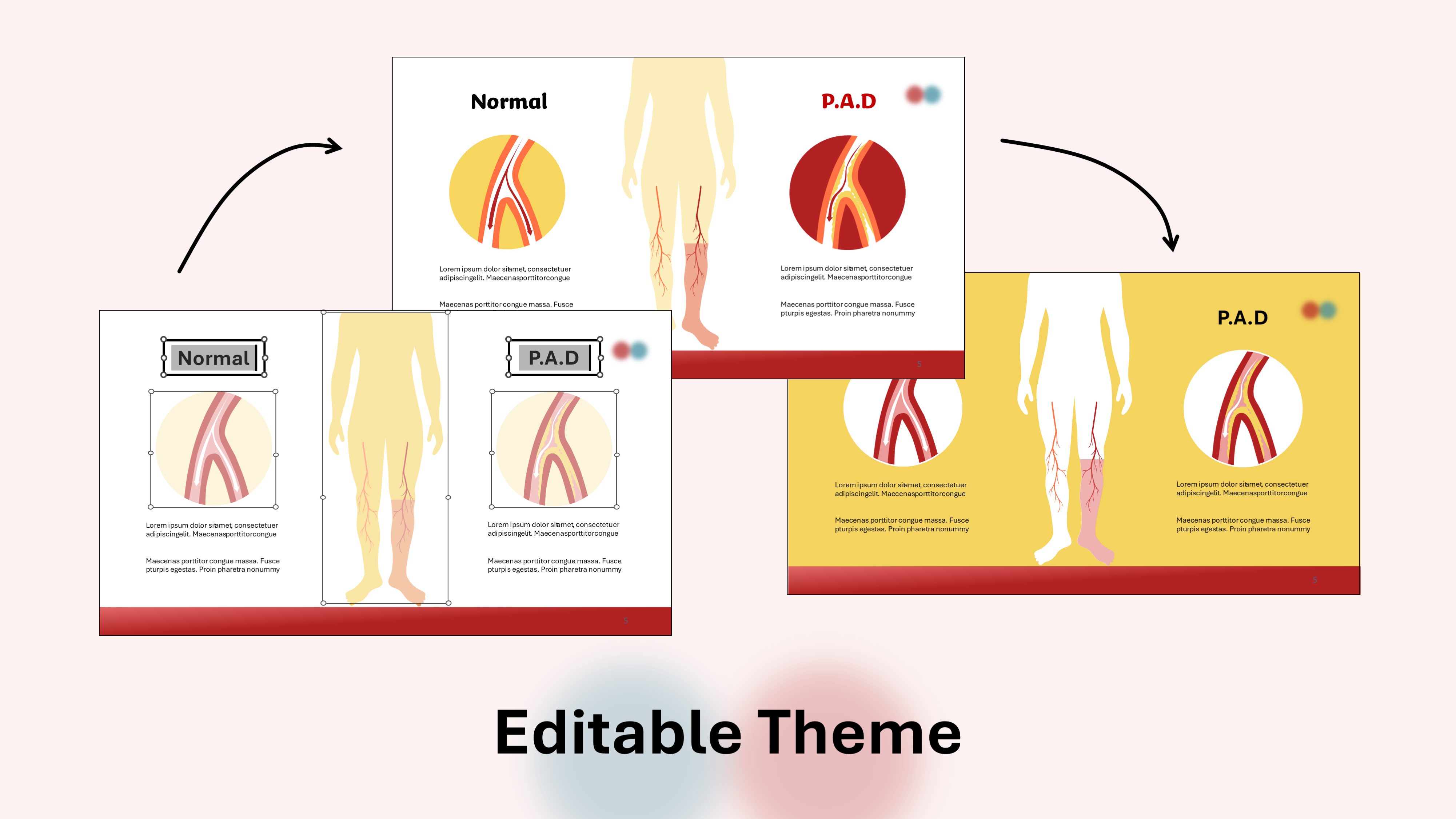
- 100% editable PowerPoint template.
- Editable colors, you can change according to your presentation style and company branding guidelines.